


How Does Bitcoin Mining Work?
It can be described as a type of mint based on electricity consumption costs, where mining devices are rewarded for solving complex operations.
Proof of Work (PoW) Mechanism
Bitcoin uses Proof of Work. Simply put:
Miners compete to solve a specific mathematical problem.
This problem is solved using the SHA-256 hash function.
The miner who solves it adds the block and receives the reward.
This task is a combination of luck and computational power.
The Role of Miners in the Bitcoin Network
In Bitcoin, miners take on the role of both accountant and security guard for the network.
They collect and verify transactions and add them to the blockchain in blocks. Their basic functions are preventing double spending, maintaining the decentralization of the network, and ensuring consensus.
Miner Revenue Model
Miners’ income consists of two main components:
Block reward and transaction fees
[Revenue = (BTC price) × (BTC earned)] – [Expenses = electricity + hardware + maintenance + financing] = whether miners can survive.
Hashrate and Bitcoin Relationship
The indicator we call hashrate actually refers to the total number of hash attempts made per second on the Bitcoin network.
The question of how strong and how expensive the network is to attack is important. The contributions that high hashrate provides to the network can be listed as follows: a more secure network, more competition, and higher costs.
Hashrate – Difficulty Relationship
In the Bitcoin network, the difficulty level is automatically adjusted approximately every 2016 blocks. This mechanism aims to produce blocks every 10 minutes on average.
If the hashrate increases, the difficulty also increases, and vice versa; that is, if the hashrate decreases, the difficulty also decreases.
To elaborate on the mechanism: an increase in hashrate indicates that the total computing power competing to find the same block on the network has increased. Since the block reward remains fixed according to the protocol, the increased computing power leads to blocks being found faster.
The Bitcoin protocol responds to this situation by increasing the difficulty level. As the difficulty increases, the amount of computation required to produce a valid block increases; in other words, the same block is found with more energy, hardware, and capital costs.
This structure can increase the cost of mining per unit of BTC. Especially in periods when the price or transaction fees do not offset this increase, mining loses its economic appeal, and in some scenarios, inefficient players may exit the network.
Current Situation for Miners
Over the years, the increase in Bitcoin’s price has led to a rapid influx of mining power into the network by those seeking to profit from this field.
Indeed, the Bitcoin hashrate, which was at very limited levels in 2010, increased by millions of times by 2013. Although the Bitcoin price also rose significantly during the same period, this increase remained at around 200 times.
This picture clearly shows that there is a positive relationship between hashrate and price, but that the increase between the two variables does not follow a linear pattern.
In other words, while the price increase encourages mining power, hashrate growth can follow a much more aggressive and compound trajectory compared to the price increase.
Today, the total hashrate on the Bitcoin network is hundreds of EH/s (exahash/second). This value means that approximately 1.1 × 10²¹ hash attempts per second are made on the network, concretely reflecting the level of security and competition achieved by the Bitcoin network.
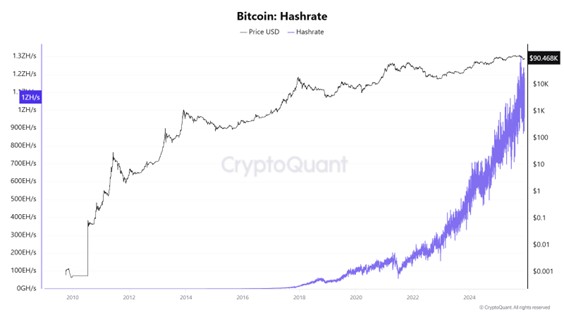
However, this high hashrate level brings not only increased security for miners, but also increased costs and shrinking profit margins.
Block rewards, which remained fixed for four years and then halved, the rising difficulty level, increased energy costs, and intense competition are putting serious pressure on miners, especially those that are inefficient and have high debt ratios.
In this context, the current picture points to a period of accelerated consolidation in the mining sector, with weak players being eliminated while strong, low-cost operators increase their share of the network.
Impact of Miner Pressure on Price Dynamics
Short-Term Effects
The financial pressure on miners inevitably reflects on Bitcoin price dynamics. Miners with declining profitability may be forced to sell part of their BTC reserves to sustain their operations.
This situation can increase volatility, particularly in the short term, by creating additional selling pressure. Historical data shows that periods of increased miner-driven sales have generally had a depressing effect on prices.
Medium-Term Balancing Mechanisms
However, the process is not entirely negative. Intense pressure on miners often corresponds to transition phases where inefficient players are eliminated and supply is rebalanced.
With the closure of unprofitable operations, the selling pressure from miners remaining active on the network decreases, and the new BTC supply entering the market takes on a more controlled structure.
(https://academy.darkex.com/tr/pazar-nabzi/hashrate-record-and-miners-search-for-new-revenue/)
Long-Term Perspective
In the long term, these stress periods often parallel a structural bottoming-out process.
If miners’ selling behavior decreases while the hashrate remains high, the Bitcoin supply becomes more predictable and creates a supportive effect on the price.
Thus, while miner pressure is a risk factor in the short term, it can be seen as a filtering mechanism that strengthens Bitcoin’s economic resilience and price stability in the long term.
Conclusion / Final Assessment
In summary, pressure on mining emerges as a dynamic that can cause temporary fluctuations in price but is a natural part of the network’s maturation process.
When examining Bitcoin’s historical cycles, it is seen that such periods are mostly phases where weak and capital-constrained miners are eliminated and the groundwork is laid for the next price cycle.
From this perspective, miner pressure can be considered a critical mechanism that both tests price dynamics and prepares the market for long-term equilibrium.
Disclaimer
The information, analyses, and opinions contained herein are provided for informational purposes only and do not constitute investment advice, financial advice, or a recommendation to buy or sell any asset. Any views expressed are of a general nature and may not be suitable for all investors. Investment decisions should be made based on individual risk tolerance, financial circumstances, and objectives, and where appropriate, with the guidance of licensed financial professionals. The author assumes no responsibility for any losses that may arise from the use of this information.