TRON Usage Areas
TRX, the native asset of the TRON network, is not just a payment instrument; it is at the center of a wide range of uses, from transaction fees to network security, from DeFi infrastructure to governance mechanisms. TRX serves as fuel for the functioning of the network, incentivizing users, providing liquidity and enabling participation in decision-making. Thanks to this multifaceted function, TRX is the fundamental building block that supports the sustainability of the TRON ecosystem. The main uses of TRX will be discussed in detail below.
Transactions and Fees
TRX is the main asset at the center of all economic activity on the TRON network. It acts as the “fuel” for every transaction, such as smart contract execution, token transfers, NFT minting, interaction with DeFi protocols, etc. Transaction fees are paid in TRX, and these fees are partially burned, helping to stabilize supply. Thus, TRX
functions both as a currency to cover the costs of using the network and as a mechanism to control inflationary pressures
Staking and Network Security
TRON uses the Delegated Proof of Stake (DPoS) consensus mechanism, where staking TRX provides voting power in the election of Super Representatives (SRs), contributing to network security and governance. Users who stake TRX gain voting power proportional to their stake, participating in network governance and supporting
network security. Stakers also earn rewards based on the portion of block rewards that the Super Representatives (SRs) they voted for choose to share with their voters.
DeFi Infrastructure
TRX is a collateral and reference asset in the financial infrastructure of the TRON ecosystem.
- Stablecoin Production: TRX is used as collateral for the issuance of algorithmic stablecoins such as USDD.
- Loan Protocols: On platforms like JustLend DAO, TRX acts as collateral for lending and borrowing.
- Stablecoin Production: On decentralized exchanges like SunSwap, TRX is the most basic liquidity pair (e.g. TRX/USDT). This makes TRX the liquidity anchor of the ecosystem, as all major trading pairs are directly or indirectly linked to TRX.
Governance
TRX is not only a transfer medium, but also an asset at the heart of TRON’s democratic governance mechanism. Users earn TP by staking their TRX and through this TP:
- Vote for Super Representative candidates who have a say in the governance of the network.
- Access system resources such as Bandwidth and Energy, allowing for cheaper or free transactions.
- Participate in decision-making processes (proposals, updates, parameter changes) that shape the future of the network.
In this way, TRX holders directly drive the development of the TRON ecosystem.
Consensus Mechanism and Incentives
The TRON network operates on a DPoS mechanism. In this system, TRX functions not only as a means of transfer, but also as a key element that ensures the security of the network. By staking their TRX, users obtain TRON Power, which gives them the right to choose 27 SRs. Thus, TRX is both at the center of governance and directly
contributes to the block production process.
SRs who take on the task of block production earn rewards for the blocks they successfully create and share some of these rewards with the community members who vote for them. This structure encourages TRX holders to actively participate in governance and also enables TRX to be used as an incentive and reward tool.
The DPoS mechanism operates with low energy consumption and a capacity of over 2,000 transactions per second (TPS). This makes TRON a powerful infrastructure for DeFi, NFT and dApp applications that require high transaction speeds. In this context, TRX serves an indispensable function for both network security and governance.
Staking
Staking is another use case for TRX. When users freeze their TRX through staking, they not only get TP, but also the necessary Bandwidth and Energy resources for transactions on the network. These resources reduce transaction fees, reinforcing TRX’s role as the network’s fuel.
Each 1 frozen TRX = 1 TP and this power is used as voting power in SR elections. TRX is therefore a central tool for both governance and the use of network resources.
When users want to unfreeze their staked TRX, there is a 14-day waiting period during which funds cannot be transferred. At the end of the period, TRX becomes free again and users can regain liquidity. This mechanism creates stability in the ecosystem by encouraging long-term holding of TRX.
TRON, a Leading Blockchain for Stablecoins
The differentiation between projects in the blockchain ecosystem depends not only on technological infrastructure, but also on measurable indicators such as the revenue model and token economy. TRON has gained a unique position by outperforming its competitors in key metrics such as stablecoin transfer volume, revenue generation capacity and staking rate. These indicators reveal that the network has become not only a smart contract platform, but
also a powerful financial infrastructure provider on a global scale.
Stablecoin Transfer Volume
In the blockchain ecosystem, stablecoins play a critical role as they provide price stability and facilitate the transfer of value between different protocols. In this context, TRON is a prominent network, especially in terms of daily stablecoin transfer volume. The high volume of stablecoin transactions taking place on the network shows
that TRON is becoming more than just a smart contract platform, but a global payment and financial infrastructure provider.
Stablecoin Transfer Volume by Chain
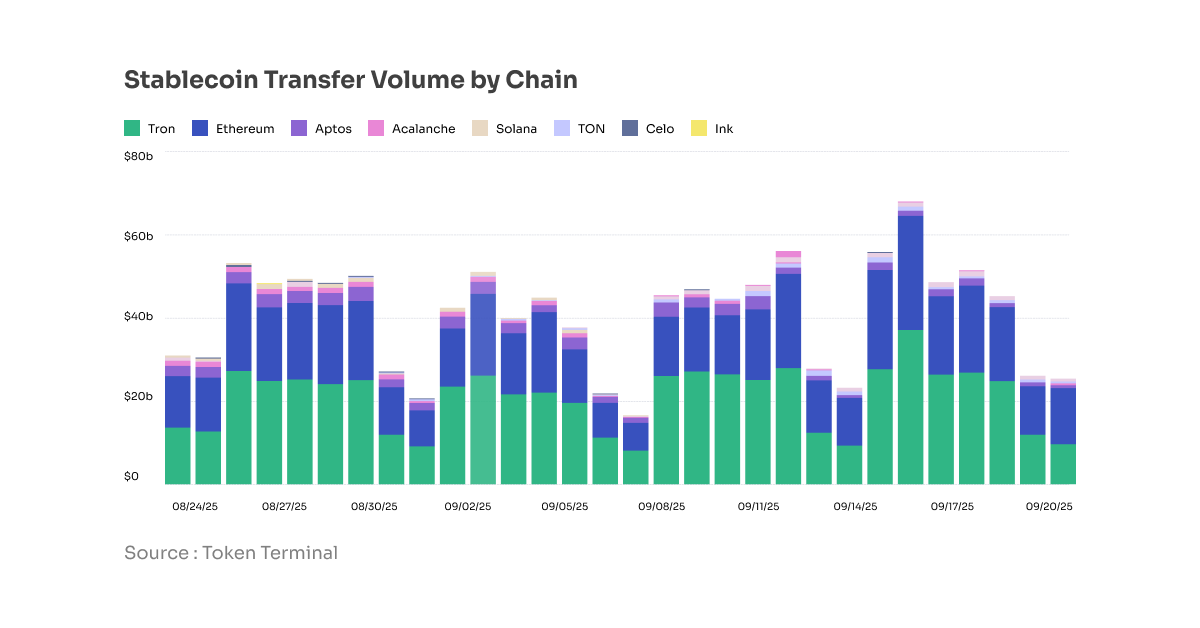
The last thirty days of data show that TRON is the leader in stablecoin transfer volume. When the chart is analyzed, it is seen that TRON is ahead of Ethereum in daily stablecoin transfers except for only three days. This trend reveals that TRON is consistently preferred by users.
In fact, according to Token Terminal data, the total monthly Tether (USDT) transfer volume on the TRON network has reached $665.9 billion. This magnitude makes TRON not just an alternative for stablecoin transactions, but one of the most dominant networks on a global scale.
Revenues
In the crypto ecosystem, not only price movements, but also the revenue generated by a blockchain stands out as a critical indicator in terms of the intensity of use of the network, ecosystem health and investor interest. Over the last year, TRON has consistently outperformed its competitors in this area, maintaining its title as the blockchain that generates the most revenue. This can be considered as a concrete indicator of both user participation and the intensity of DeFi and token transactions on the network.
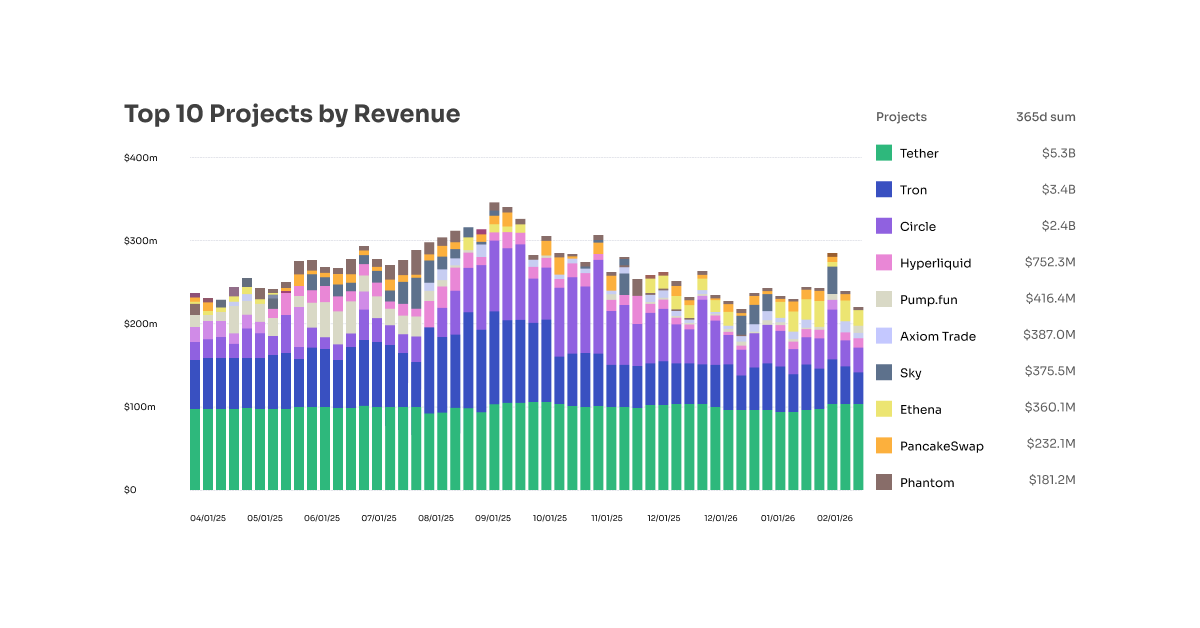
TRON has been steadily increasing its revenues since its launch, and according to Token Terminal data, its total revenue for the last 1 year is approximately 3.6 billion dollars. This figure is approximately five times the revenue generated by Ethereum in the same period. As of August 29, 2025, TRON network transaction fees were reduced by 60% as part of a proposal submitted and accepted on August 26, 2025. Although there is a decrease in revenues with the short-term effect of this regulation, TRON still maintains its position as one of the highest revenue generating networks among blockchains.