


MARKET COMPASS
The Iran War and Digital Assets
Developments in the Middle East continue to be the focus of the entire world. Predicting when the war might end remains extremely difficult, and statements from the parties involved paint a mixed picture. Amid this chaotic process, while fluctuations in oil prices are particularly noteworthy, we are also seeing a significant trend in Bitcoin prices.
In recent months, despite the uncertainty brought by geopolitical tensions, Bitcoin’s price—which has behaved like a high-beta, risky asset—has managed to continue rising and has sustained demand as if it were a class of assets that investors use as a “value-preserving tool isolated from traditional markets.”
As we noted in our report last week, “According to our statistical and econometric models, Bitcoin is currently serving as a ‘safe haven’ that markets use to avoid risk in the short term.” We do not currently anticipate this pricing behavior extending into the long term; however, in the short term, as long as the geopolitical agenda maintains its influence on pricing dynamics, we believe the upward trend could continue, albeit with occasional short-term corrections.
Developments regarding the ongoing conflict between Iran and the U.S.-Israel alliance will remain on the market’s agenda in the coming week. Additionally, the digital world’s attention will be focused on the DC Blockchain Summit, scheduled for Tuesday and Wednesday, which will feature prominent speakers. On Wednesday evening, we will also receive the decisions from the U.S. Federal Reserve’s (FED) March Federal Open Market Committee (FOMC) meeting. These headlines, emerging first, appear poised to guide asset prices throughout the new week.
March 18 – A Critical Date for Bitcoin: March 18 FOMC Decisions
The U.S. Federal Reserve’s (FED) second Federal Open Market Committee (FOMC) meeting of the year will take place on March 17–18, with decisions announced on March 18. The FOMC is expected to keep the policy interest rate unchanged (according to the CME FedWatch Tool at the time of this report’s preparation), and the decisions, their rationale, and accompanying statements carry critical importance for global markets. The Bank’s current policy interest rate stands at 3.50–3.75%.
We are monitoring the final FOMC meetings chaired by Jerome Powell, whose term as Fed Chair will end in May. Beyond the issues he faced with U.S. President Trump, Powell has had to contend with numerous challenges, including updated data sets, a government shutdown, high tariffs, geopolitical developments, and macroeconomic dynamics. Recent shifts in the variables of this equation present a separate problem for Powell to resolve. Inflation remains above the Fed’s 2% target, and the labor market is failing to produce consistent or meaningful results based on the latest figures. Amid this dilemma, as we saw in the minutes of the last meeting, the FOMC must avoid rushing to cut rates and is even presenting a framework where further cuts may not be justified. However, the Trump administration’s aggressive stance leaves little room for this, and we currently lack clear information on the stance that Kevin Warsh, the nominee for the next Fed Chair, will adopt. Consequently, the March FOMC meeting will provide key insights into whether we will see further rate cuts for the remainder of the year—and, if so, how many.
Now, to better prepare investors for FOMC day, we will detail what to expect step by step on March 18.
Decision Day
1- Will the interest rate remain unchanged as expected: As we briefly summarize the process awaiting us on the evening of March 18, we must start with the interest rate decision. First and foremost, markets will focus on whether the Fed keeps its policy rate unchanged. As mentioned above, according to the CME FedWatch Tool, markets—at the time this report was prepared—expect the current rate to remain unchanged.

Source: Bloomberg
If the Fed keeps interest rates unchanged as expected, we do not anticipate any new market pricing in response to this decision. However, if the Fed decides to cut rates by 25 basis points, bringing the rate down to 3.5%, we could see a reaction where the dollar weakens, risk appetite increases, and relatively risky assets—including cryptocurrencies—gain value.
2- Economic Projections and the Dot Plot:
At four of its eight meetings held throughout the year, the FOMC publishes forecasts regarding certain economic indicators and how the policy rate might change in the future. The meeting scheduled for March 17–18 will be one of these. Consequently, these documents, which will be released simultaneously with the interest rate decision, will constitute another key set of information influencing prices.
What the Fed thinks about the health of the economy is, of course, very important. We can understand this perspective by examining how officials expect macroeconomic data to change in the coming period. Changes in these projections will be closely monitored, and in particular, any potential updates to the PCE price index (the indicator the Fed uses to track inflation) will provide insights into the path of interest rate cuts. A strong upward revision could imply that the Fed will not be in a rush to cut rates in the coming period, while a downward revision could suggest it might implement rate cuts relatively more quickly.
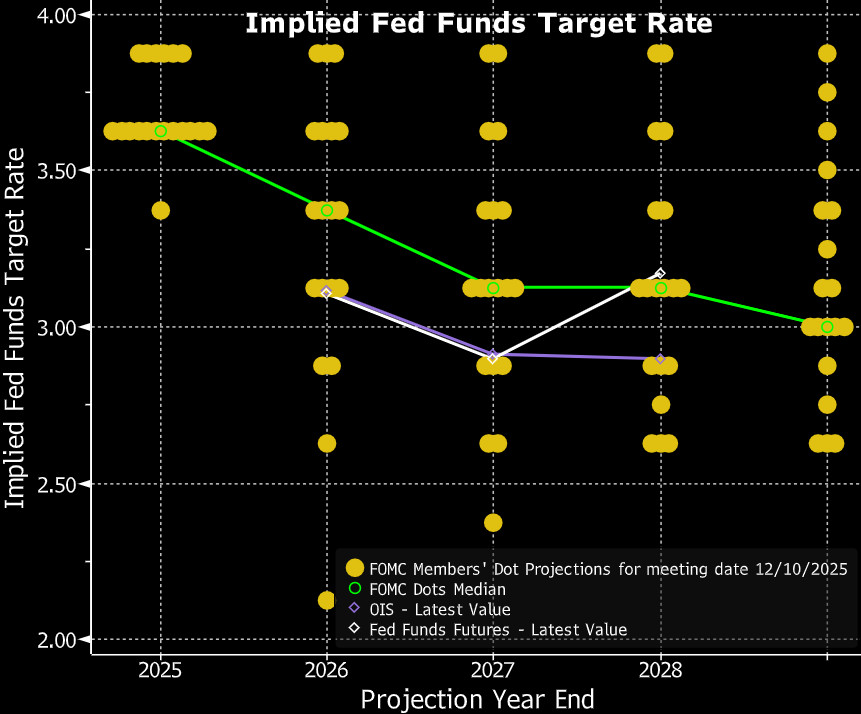
FOMC Dot Plot Table
Source: Bloomberg
Within the same document, there will be a table known as the “dot plot,” which shows FOMC members’ projections regarding changes in the policy interest rate. In the image above and also in the table below, you can see the average expected rates based on the dot plot published at the December meeting.

Source: Bloomberg
Markets expect the Fed to cut rates by 25 basis points in December following the challenges posed by the Iran conflict. Previously, the expectation was for the first 25-basis-point rate cut to occur in July, followed by a potential additional cut in October. It is not unusual for these expectations to shift in light of new developments and data. Changes in the dot plot that could alter market expectations for rate cuts may lead to a reshuffling of the deck in the markets and shifts in pricing behavior.
A general downward revision in the interest rate projections we will see in the dot plot could complete the equation where digital assets could gain value amid weak dollar demand. An upward revision, however, could have the opposite effect.
3- Fed Chair Powell’s Presentation: Half an hour after the release of the FOMC statement, the policy interest rate decision, economic projections, and the dot plot, attention will shift to Chair Powell’s press conference. Powell will first explain the decisions and their rationale from behind the podium, and then the session will move to the Q&A portion with the press. Volatility in prices may increase during this segment.
The significance of the Chair’s remarks will depend on the nature of the decisions we outlined above. However, the messages Powell conveys regarding how the path of interest rate cuts will take shape in the coming periods will be critical. If Powell signals that interest rate cuts will be necessary in 2026, we may see this have a positive impact on digital assets. In the opposite scenario, we may see pressure on Bitcoin. It is also worth noting that Powell’s term ends this May. Therefore, it would be more accurate to evaluate Powell’s statements within this projection and investment horizon.
March 17–18 – The DC Blockchain Summit Will Be the Focus of the Digital World
The “DC Blockchain Summit,” which will bring together policymakers, regulatory officials, and industry leaders, will take place this week in Washington, D.C. The event, which will feature officials such as Securities and Exchange Commission (SEC) Chairman Paul Atkings, Commodity Futures Trading Commission (CFTC) Chairman Michael Selig, and Senator Cynthia Lummis, alongside leading figures in the industry, will address various topics including crypto regulations, the adoption of digital assets, and crypto infrastructure. Statements regarding the legal regulation of crypto assets could be particularly significant and may lead to changes in the prices of digital assets. Therefore, this event will be among the week’s key developments.
Other Key Macroeconomic Indicators and Developments
March 16 – U.S. Empire State Manufacturing Index; This is a diffusion index based on a survey of manufacturers in New York State. It is released monthly around the middle of the current month, with readings above 0 indicating improved conditions and values below 0 signaling deteriorating conditions. It covers approximately 200 manufacturers in New York State and is derived from a survey asking participants to assess the relative level of general business conditions. Data exceeding forecasts could have a positive impact on digital assets.
Important Economic Calendar Data
Click here to view the weekly Darkex Crypto and Economy Calendar.
Information
*The calendar is based on the UTC (Coordinated Universal Time) time zone. The calendar content on the relevant page is sourced from reliable data providers. The news items in the calendar, the date and time of the news announcements, any changes to previous figures, as well as forecasts and actual figures, are provided by the data provider institutions.
Darkex cannot be held responsible for any changes resulting from similar situations. You can also check the Darkex Calendar page or the economic calendar section in the daily reports for any changes in the content and timing of data releases.
Legal Notice
The investment information, comments, and recommendations contained in this document do not constitute investment advisory services. Investment advisory services are provided by authorized institutions on an individual basis, taking into account each person’s risk and return preferences. The comments and recommendations contained in this document are of a general nature. These recommendations may not be suitable for your financial situation or your risk and return preferences. Therefore, making an investment decision based solely on the information contained in this document may not result in outcomes that align with your expectations.