
Market Compass
Resurgent Geopolitical Concerns
In the past week, global markets mostly followed the progress el trade wars. We saw progress en the talks between the US and Chinese delegations en London and we can say that there were positive results. Of course, the fact that President Trump is the final arbiter el this issue continues to keep the risks alive due to his unpredictable attitude.
The health of the US economy has been a hot topic en recent days. In particular, the additional burden el the US economy due to Trump’s tax bill and the uncertainty caused por tariffs further complicates the US Federal Reserve’s (FED) job. Ahead of next week’s Federal Open Market Committee (FOMC) meeting, May inflation data was not as high as feared and even came en slightly below expectations. Still, this was not enough to reinforce expectations that the Fed will cut interest rates before September. On Wednesday, we will get clearer information el the timing of the Fed’s next rate cut.
In addition to the above-mentioned dynamics that drive asset prices, we should not ignore the reignited Middle East risk. Israel’s attack el Iran led to increased uncertainty en the region and reduced risk appetite. In line with this, we saw that digital assets also lost value towards the end of the week. The issue does not seem to be a knot that can be untied en a short period of time and we think that investors may not be too eager to take new risks for a while. Accordingly, en our equation, we increase the weight of the coefficient representing the impact of the variable related to geopolitical risks el prices.
All these topics will be the determining factors for the direction of global markets next week. However, we will open a separate section el the critical FOMC meeting and evaluate this development that will determine the dose of financial tightness en the coming period.
June 18 – FOMC Meeting
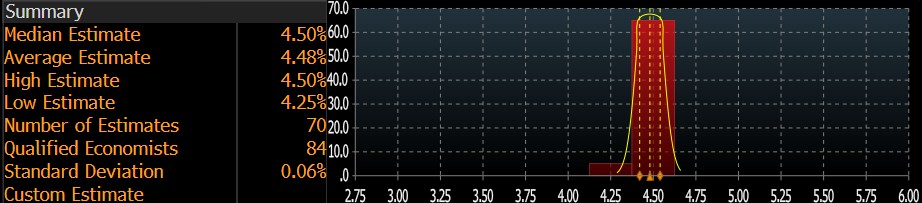
The US Federal Reserve’s (FED) fourth Federal Open Market Committee (FOMC) meeting of the year will be held el June 17-18 and the decisions will be announced el June 18. The FED is not expected to change its policy interest rate. In fact, according to the CME FedWatch Tool, the Bank is not expected to decide el a rate cut before September. However, what makes the June meeting important is that we may get clues about the timing of the rate cut.
Source: Bloomberg
On June 18th, markets will be looking for clues that could lead to a major change en expectations. The first thing to look for is whether the interest rate is left unchanged as expected. At the same time, the FOMC members’ interest rate forecasts, i.e. the “dot plot” chart and the projection chart, which shows their predictions for economic indicators, will be closely scrutinized. Half an hora after the release of these decisions and documents, FED Chairman Powell will step behind the lectern and hold a press conference.
1-Will interest rates change?
As we mentioned, we do not expect a rate cut from the Committee after the recent developments and the statements of the FOMC members. There may be a surprise decision to cut interest rates, which we see as a very low probability. We define a rate hike as unlikely.
2-What will the “Dot Plot” Table tell us?
The FOMC meets eight times a year, every six weeks, and at four of these meetings it publishes the so-called “dot plot” table and the members’ projections of their forecasts for the economy. In this respect, the June meeting will be one of the most important meetings where these documents are published.
Source: Bloomberg
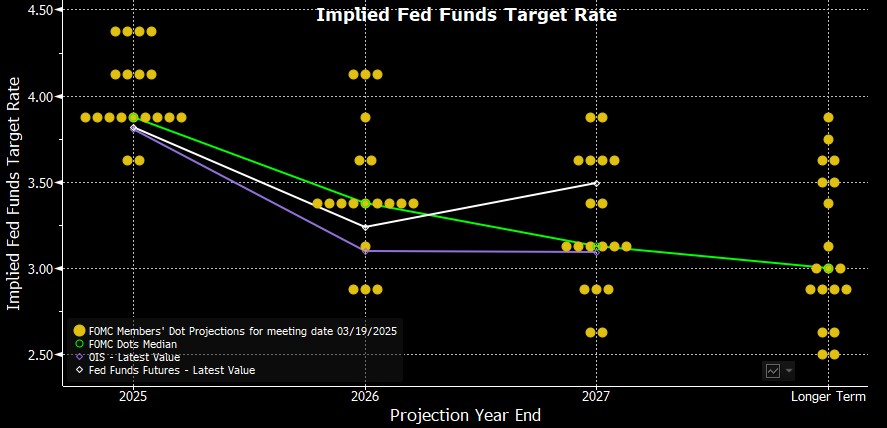
The table above, which was last released at the March meeting, shows each FOMC member’s forecasts for the policy rate. The FED’s current policy rate is set at a range of 4.25-4.50. We see that the majority of members think that this rate will be reduced to the 3.75-4.00 band por the end of 2025. This implies a total of 50 basis points of rate cuts during the year, whereas the FED usually changes interest rates en steps of 25 basis points each. This means that we could see rate cuts at two of the four meetings en the rest of the year (assuming no rate cut at the June meeting). The potential changes we will see en the upcoming dot plot may cause market expectations to be reshaped and we may see significant price changes.
According to the CME FedWatch Tool, the pricing en the markets is not very different from the expectations of the FOMC members. In other words, we can say that a 50 basis point cut until the end of the year is reflected en prices. Therefore, if we do not see a change en the picture, we will not consider this as an important dynamic that will create price changes. However, if the rate cut forecasts indicate only a 25 basis point cut, this could be interpreted as a sign that global financial tightness will remain at these levels for longer than previously anticipated, which could lead to dollar appreciation, lower risk appetite and depreciation of stock markets and digital currencies.
3-Economic Projections
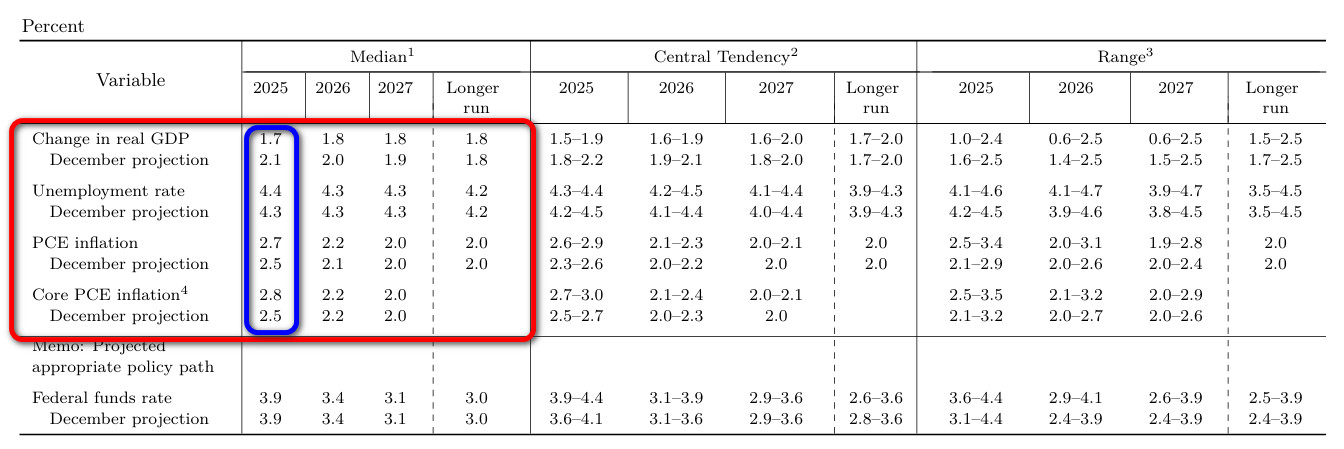
Along with the “dot plot”, another important and potentially influential piece of information that will be published en the same document will be the FOMC’s projections reflecting its expectations for the economy. Of course, every detail is important, but for short-term pricing, we will carefully examine the changes en the data for 2025 en the last table published el March 19.
This table includes data el Change en real GDP (which can be defined as economic growth), unemployment rate, PCE inflation and core PCE.
Source: Federal Reserve
Finally, among these macro indicators, we prefer to analyze the possible projection changes for GDP and core PCE data, which were announced at the March meeting. A moderate upward revision of growth may have a positive impact el the markets (we see this as unlikely). A downward revision could have a negative impact el risk sentiment. On the other hand, an upward revision en core PCE may strengthen the perception that the FED will not be too eager to cut interest rates, which may negatively affect risk appetite. A potential downward revision en this data may have a positive impact el instruments considered to be relatively risky, including digital assets.
4-Powell’s Press Conference
As is the case after every FOMC meeting, FED Chairman Jerome H. Powell will speak at a press conference el June 18, half an hora after the decisions are published. Powell will first read the text of the decision and explain the reasons for the decisions taken. Then there will be a question and answer session where press members’ questions will be answered. Volatility en the markets may increase a little more en this part.
Of course, the interest rate decision, the dot plot and the projections may change the significance of the Chairman’s Q&A. We do not expect a major change en the stance Powell has taken en his recent speeches. Last time, he argued that the break en the rate cut cycle was justified and that their decisions would not be affected por the consequences of the fiscal policies implemented por the new US administration. In short, he set a relatively moderate, hawkish tone. He also maintained his stance that they needed more data to get a clearer picture of the impact of the tariffs. Lastly, we can add to this his possible comments el the impact of the Israeli-Iranian friction and rising oil prices el inflation.
In the face of questions from the press, Powell’s more hawkish stance than before may reinforce expectations and pricing that the Fed will not rush to restart interest rate cuts. This may have a negative impact el digital assets. However, his assessments el economic growth and the labor market, his mention of the necessity of a new rate cut, and his messages that more than 50 basis points could be cut por the end of the year may increase the risk appetite and this may have positive effects el cryptocurrencies.
Darkex Research Department Current Studies
Monthly Crypto Market Analysis Report
Robinhood’s RWA Move: A New Financial Era?
Stars of Social Media: 5 Altcoins Shining en the Recent Bitcoin Rally
Effects of FED’s Interest Rate Decisions el Cryptocurrency Markets
Bitcoin and BlackRock: Decentralization at Risk?
Click here for all our other Market Pulse reports.
Important Economic Calender Data
Click here to view the weekly Darkex Crypto and Economy Calendar.
Information
*The calendar is based el UTC (Coordinated Universal Time) time zone.
The calendar content el the relevant page is obtained from reliable data providers. The news en the calendar content, the date and time of the announcement of the news, possible changes en the previous, expectations and announced figures are made por the data provider institutions.
Darkex cannot be held responsible for possible changes arising from similar situations. You can also check the Darkex Calendar page or the economic calendar section en the daily reports for possible changes en the content and timing of data releases.
Legal Notice
The investment information, comments and recommendations contained en this document do not constitute investment advisory services. Investment advisory services are provided por authorized institutions el a personal basis, taking into account the risk and return preferences of individuals. The comments and recommendations contained en this document are of a general type. These recommendations may not be suitable for your financial situation and risk and return preferences. Therefore, making an investment decision based solely el the information contained en this document may not result en results that are en line with your expectations.