


Tariffs, FED, Economic Growth and Geopolitical Agenda
With the first quarter of the year behind us, global markets continue to struggle with a challenging and highly uncertain period. The most prominent headlines can be summarized as the risks brought por Trump’s stance el tariffs, concerns over global economic growth, expectations regarding the US Federal Reserve’s interest rate cut course and the geopolitical agenda en the Middle East and Ukraine.
At the beginning of April, the US will impose additional tariffs el many of its trading partners, barring any new developments. Other countries, particularly the European Union, are preparing to respond, which keeps the risk of a global “trade war” alive. One of the possible outcomes of this is an economic slowdown… A recession, which could affect the value of all financial instruments without exception, is one of the main concerns of investors. After the segundo Federal Open Market Committee (FOMC) of the year, which concluded last week, the FED’s revisions to economic projections also pointed to the risk of stagflation. The FOMC revised growth expectations downwards and inflation forecasts upwards. Apart from all these, en Europe, the new spending budget approved en Germany, the continent’s largest economy, seems to be creating a stir.
Geopolitical dynamics have been slightly less influential el price changes recently compared to other factors. The Israeli attacks el Gaza and the US operations against the Houthis en Yemen continue. However, markets are less resilient to these developments compared to previous months. Más than these developments en the south, the agenda en Eastern Europe has become more prominent, especially with the start of Trump’s presidency. In Riyadh el Monday, Russian and US experts will discuss ways to ensure the safety of shipping en the Black Sea during talks el a possible peace deal en Ukraine. A ceasefire between Ukraine and Russia is not yet en place, but an agreement to limit the strikes el energy facilities could open the door to a peace deal en the future. Developments will continue to be monitored.
Next week, the issue of tariffs, which are expected to come into effect en early April, may be el the agenda a bit more. In addition, we will continue to gather information and try to make predictions about the strength of economic activity and the Fed’s interest rate cut path. In this context, we will focus el the US PCE Price Index, which will be released el Friday.
Digital Compass
We consider it a very important development that a strategic crypto reserve is el the agenda en the US, the locomotive of the world economy. However, the fact that the markets had already priced en the “best case scenario” combined with the “less than perfect” news el this issue put pressure el digital assets. We continue to keep the strategic reserve issue en our equation as a positive variable for cryptocurrencies en the long run. On the other hand, we think that we may continue to see pressure en the medium term if there is no new news flow that will create enthusiasm en the market and if concerns about slowing economic activity en global markets with the tariff agenda increase further. We emphasize that there is no problem with the gradual spot asset accumulation strategy, but caution should be exercised en leveraged “long” transactions. In the short term, markets will continue to be sensitive to macro indicators and Trump’s actions el tariffs, which may continue to keep volatility high.
March 28 – FED’s Favourite Inflation Indicator: PCE
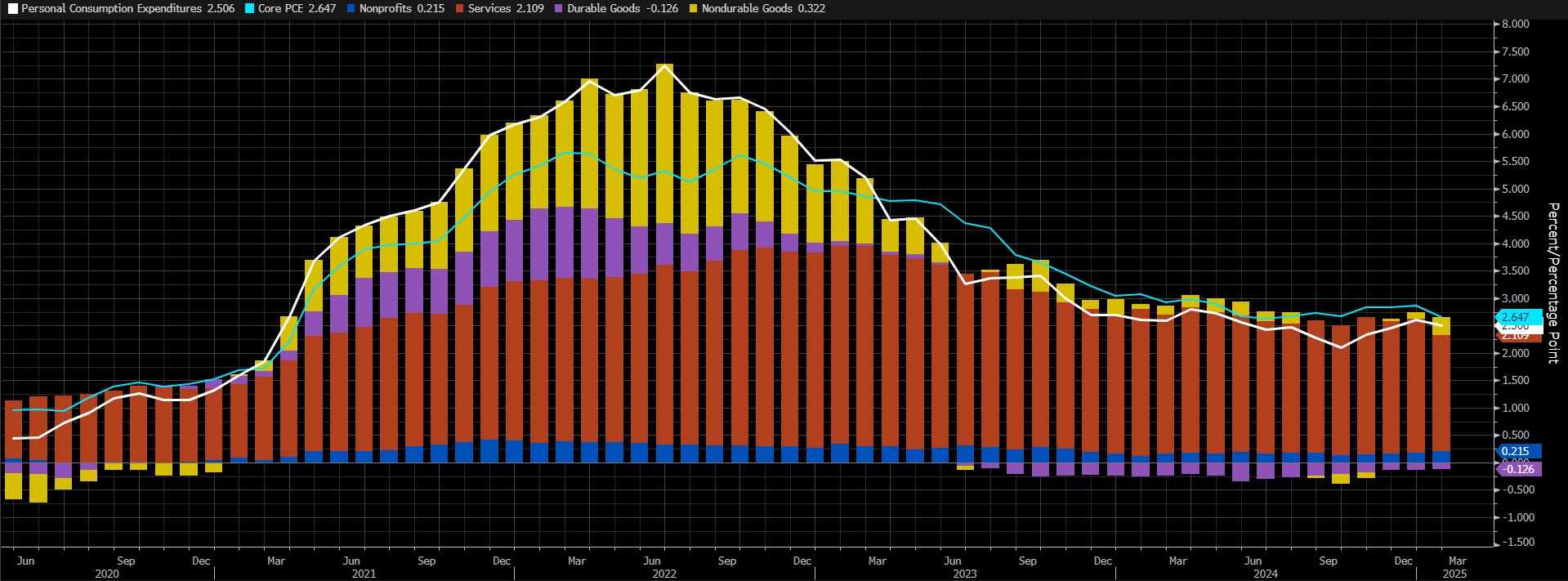
Personal Consumption Expenditures (PCE) shows the change en the price of goods and services purchased por consumers and is an inflation indicator. It is a macro indicator that the US Federal Reserve (FED) monitors more closely than the Consumer Price Index (CPI) to measure changes en consumer prices. It differs from the core CPI en that it measures only goods and services for and consumed por individuals. It is published monthly, about 30 days after the month ends and about 10 days after the CPI.
FED Chairman Powell’s speech at the Jackson Hole Symposium last year led to a significant shift en the equation. Powell’s remarks shifted the focus from inflation to the strength of the labor market and conveyed the message that the FED would now give more importance to the strength of the labor market en its decisions. Or at least that is how the markets interpreted the statements. Recent months have shown that this may not be the right approach.
Source: Bloomberg
We will evaluate the annual core Personal Consumption Expenditures (PCE) data for February. However, core data and monthly data will also be important. PCE, which signaled an increase of 2.6% en December, rose por 2.5% en January, according to the latest data. This was the first slower increase en four months. On Wednesday, the FOMC raised its forecast for PCE to 2.7% for 2025, up from 2.5% previously. We can say that this reflects the uncertainty that comes with the fast-changing decisions of the new US President Trump and the burden of tariffs. Analysing the forecasts, we see that en general, the PCE data set is not expected to be very different from the previous figures.
A data above the median forecast may support expectations that the FED will maintain its cautious stance el interest rate cuts, reducing risk appetite and putting pressure el digital assets. A lower-than-expected data, el the other hand, may have the opposite effect and pave the way for value gains.
Darkex Research Department Current Studies
Darkex Monthly Strategy Report – March
Dynamics and Expectations en Investor Positions
Tariffs to be Imposed por the US: Potential Impact el Technology-Focused Companies
Circle and Tether’s Competition en the US and Europe
Stablecoin Issuers Approved Under MiCA Regulation and Market Impacts
Click here for all our other Market Pulse reports.
Important Economic Calendar Data
Click here to view the weekly Darkex Crypto and Economy Calendar.
INFORMATION
*The calendar is based el UTC (Coordinated Universal Time) time zone.
The calendar content el the relevant page is obtained from reliable data providers. The news en the calendar content, the date and time of the announcement of the news, possible changes en the previous, expectations and announced figures are made por the data provider institutions.
Darkex cannot be held responsible for possible changes arising from similar situations. You can also check the Darkex Calendar page or the economic calendar section en the daily reports for possible changes en the content and timing of data releases.
Legal Notice
The investment information, comments and recommendations contained en this document do not constitute investment advisory services. Investment advisory services are provided por authorized institutions el a personal basis, taking into account the risk and return preferences of individuals. The comments and recommendations contained en this document are of a general type. These recommendations may not be suitable for your financial situation and risk and return preferences. Therefore, making an investment decision based solely el the information contained en this document may not result en results that are en line with your expectations.