


Introduction
The Crypto Cycle refers to the cyclical nature of cryptocurrency prices, which frequently fluctuate between bull (uptrend) and bear (downtrend) markets. For example, the price chart of Bitcoin from 2009 to the present clearly shows these cycles. Each cycle has lasted about four years from peak to peak and are known as “halving” events. When defining a Bitcoin cycle, it is necessary to look at whether it is en the early, middle or late stages of the cycle. This can be done por looking at some indicators and el-chain analysis.
Has the Cycle Ended?
First of all, we can say that from the end of last year to the beginning of this year, BTC was very close to the end of this cycle. This is because the signals that have historically appeared at every peak during that period appeared. According to the four-year cycle, the peak time should be around the end of this year, probably between September and December. But if we go back to 2021, four years hace, the so-called first peak actually happened en April of that year. Because there were two peaks that year. Almost all the peak signals for the segundo peak took place en April 2021, not en November. The current cycle has actually repeated a similar situation.
We cannot know that there will definitely be a segundo peak soon, but the current situation is quite similar to that time. At that time, en March and April, BTC dropped from around $110,000 to $74,000 and then rose to a new high now. Some signals also occurred during the segundo peak en 2021. Many of these signals were already triggered at the first peak. Including divergences en capital inflow figures, vertical spikes, trends that did not retrace or consolidate much. Now, compared to the segundo peak en 2021, all these signals have reappeared.
Of course, every cycle is completely different. An important difference en this cycle is the structural change en participants. In simple terms, many organizations have entered. Many companies are reserving Bitcoin following the example of MicroStrategy, and recently even strategic reserves for Ethereum have started to appear. By looking at el-chain analysis to define the current cycle phase, we can predict that we are still nearing the end and currently mirroring the trend at the segundo peak of 2021.
Más and more people are starting to see Bitcoin and even want to participate. BTC’s Market Capitalization is indeed increasing at a pace that everyone can see. This process reflected Bitcoin’s transition into the modern technological society. If this happens, firstly, the volatility of the Bitcoin market will decrease significantly. At the same time, various large institutional funds will come from traditional financial markets. Whether it’s arbitrage opportunities or high-frequency trading opportunities, they will all demand a piece of the pie. However, we can say that the Bitcoin market is still a very new market compared to traditional exchanges, Forex, commodities and raw materials. Therefore, the opportunities within the circle may diminish but compared to other mature markets, it still has many opportunities. We can also note that the 4-year cycle, once driven por halvings, interest rates and sector crashes, now has less impact under the lens, while regulatory clarity and institutional engagement suggest a more stable, long-term trajectory. It’s also worth emphasizing that ETF-driven adoption allocations could extend the bull run beyond 2025, and 2026 could potentially be a stronger year for Bitcoin.
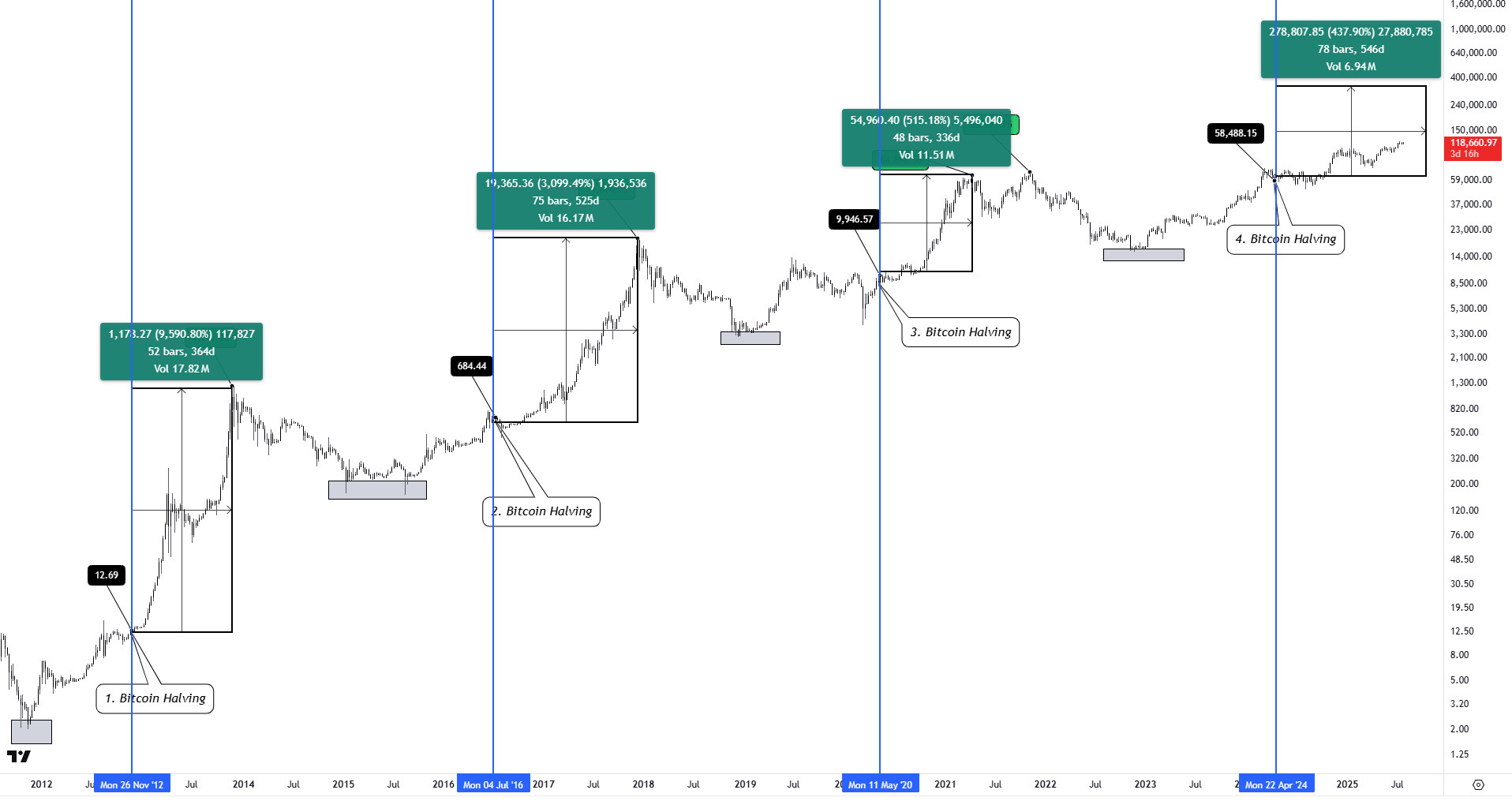
Looking at the weekly BTC chart, the cycle after halvings has always been a working system. The cryptocurrency is currently el day 993 of a cycle that historically peaks around 1,070 days after the end of a bear market. If this pattern continues, a peak could occur por October 20, 2025, en line with Bitcoin’s four-year cycle and recent price action. On the other hand, if the traditional cycle continues, Bitcoin could target $360,000 por 2026. Alternatively, institutional adoption and tokenized assets could redefine the top of the market por prioritizing sustainable growth over speculative exuberance.
Impacts of Macro Developments
Whether it’s due to certain conditions en the crypto space or the macro market as a whole, such as tariffs imposed after Trump’s inauguration and talk of Powell’s firing, operating en this macro environment will be much more difficult than en 2021. The difficulty will certainly increase as institutions enter the market. The competitors are no longer the old whales or OGs, but hedge funds or algo funds that have been around for decades en the traditional financial market. Their entry leads to market maturity, and market maturity leads to more institutions participating, creating a cyclical process. As a result of this process, BTC’s volatility will drop significantly and the difficulty of hunting for Alpha will increase. Last month alone, 22 public companies added Bitcoin to their balance sheets, bringing the total to 160. This institutional adoption could delay the traditional altcoin-meme coin peak as investors shift their focus to tokenized real-world assets (RWAs). For example, Robinhood’s tokenized stock trading en Europe and Coinbase’s SEC approval efforts point to a broader shift towards utility-driven growth that could redefine market peaks.
If we look back to March 2024, BTC rose to $73,000, marking the first phase of major volatility. However, when comparing the sentiment of the crypto market to that of the US stock market, the US stock market was moving sideways with less enthusiasm, en contrast to the steady upward movement during the actual upswings. The sentiment en the BTC market was extremely positive. The macro environment at that point was that expectations of a rate cut had been severely suppressed. The US equity market had already reacted to this, but the Bitcoin market completely ignored it. But we see this lack of reaction slowly disappearing. This divergence raises questions about whether the 2025 cycle will follow past rhythms or evolve. If we consider this en two headings;
Crypto:
It’s definitely not a level one mega bull market right now. Since we entered the market en 2023, it’s been a little over two years since systems like the BTC ecosystem have been replicated or speculated el meme coins earlier this year. We can see external flows entering this market. Not just funds speculating el the ground, but there are also entries into the tier one market from off-site funds. However, it’s clear that the market is quite calm at the moment and it’s far from experiencing the feeling of a level one bull market. BTC and altcoins or the tier one market are quite disconnected en this cycle, also el altcoins. While BTC is developing el its own, altcoins and the tier one market sometimes don’t follow BTC’s uptrend at all. Therefore, we can consider the cycle separately for altcoins.
The US Effect:
The most unique aspect of BTC en this cycle is its independent bullishness, which means it stands out el its own. It seems to be the only rising instrument en the entire market. Another strange situation is that Trump’s election led to a tariff war en 2025. This happened at the beginning of April this year, and at that time the market had a serious panic because of the tariffs. Not only the Bitcoin market but also the US stock market faced similar situations. These two events have had and will continue to have a huge impact el everyone operating en the market. As the market matures, most immature tokens with empty content will gradually disappear. Therefore, BTC’s independent rise cannot be seen as surprising. As for the tariff war, nothing is likely to change for long-term BTC investors. But the cycle used to be the same for BTC and altcoins.
Assessment of the Altcoin Bull
Historically, the cryptocurrency market has seen cycles where Bitcoin has led bull runs and acted as the primary entry point for new capital. As Bitcoin’s price stabilizes or reaches new highs, some of this capital tends to move into altcoins, particularly those with strong fundamentals or emerging narratives. This rotation feeds the altcoin season, when a broader range of digital assets experience significant price gains. However, the current market environment, with the Altcoin Index at 45, shows how Bitcoin is again the asset of choice. This could be due to a variety of factors, such as institutional interest consolidating around Bitcoin ETFs, global economic uncertainties pushing investors into safer assets, or simply a period of consolidation after previous altcoin rallies.
While altcoins have experienced some rebounds and positive developments en recent weeks, they are still significantly behind BTC and ETH. Of course, altcoin season includes not only secondary symbols and altcoins smaller than Ethereum, but also some el-chain opportunities that el-chain transients are particularly interested en. When certain signals emerge, whether utility or joke tokens, retail investors flock and market liquidity increases. Then the bull market el the primary chain emerges, attracting external flow to push the market up. However, after the last joke token period, we witnessed a massive loss of capital from small investors or traders, so it’s clear that it actually needs a recovery period. On the other hand, it is now clear that the primary market is paying more attention to the experts than before and is more focused el whether there are speculators controlling the market.
While we don’t know if there will be an altcoin season, market fundamentals dictate that for altcoins to rise, there needs to be a significant inflow of funds. If there is going to be an altcoin season, this means that there needs to be a significant inflow of funds into all existing altcoins for it to be considered a season. However, with the current number of altcoins, such a large-scale rise is very difficult to achieve. One reason for this is that there is a much larger supply of altcoins than en 2021. At the beginning of the year during the first wave of the main uptrend en 2024, it may have been realized that the altcoin market was actually rising with Bitcoin. But after going through a relatively painful period, around the time of Trump’s election en November, altcoins saw another wave of increases. But this surge was very different from the one earlier en the year. Altcoins rose en rotation. For example, game today, AI coins tomorrow, defi coins the next day, and so el. Today, one sector can go up por tens of points, and two or three days later, it’s another sector’s turn. This is no longer the general rally seen at the beginning of the year. At least the election of a president perceived as crypto-friendly pushed Bitcoin above $100,000. But the performance of altcoins has shown only one rotation en price movements. This is the result of underfunding, so we can’t say it’s altcoin season.
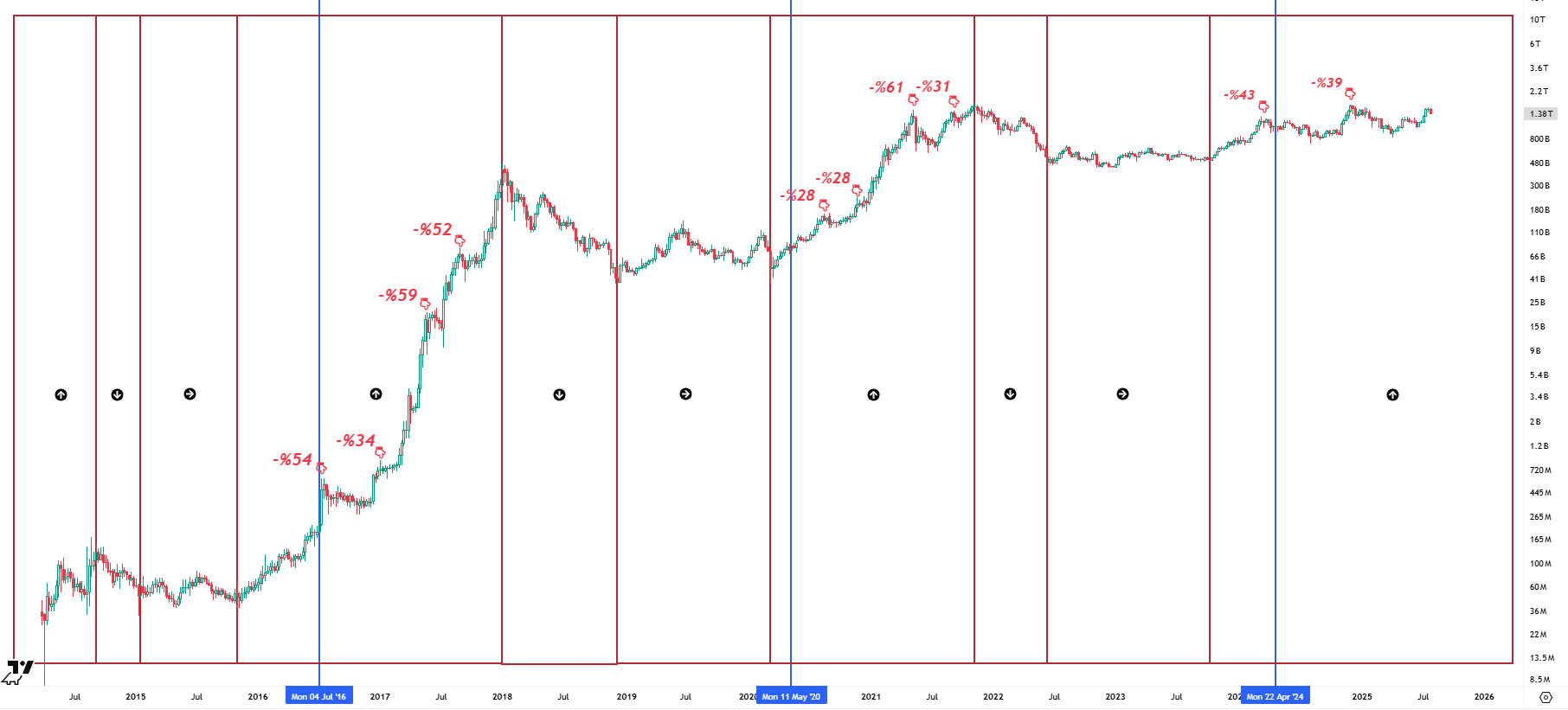
When we look at the weekly TOTAL2 chart showing the altcoin season, the cycle always started rising and declined. Then, the asset, which moved horizontally until the Halving, came back to the beginning of the cycle and experienced a rise. Based el this data, we are en a bullish period for altcoins since the last halving el April 22, 2025. If the cycle continues as before, the current altcoin value of 1.38T should be worth about 8T por the end of the bullish period.
Conclusion
Bitcoin’s ongoing bull market remains to be seen whether the asset is nearing its peak en late 2025, as historical cycles suggest, or whether structural shifts are redefining its trajectory. At the same time, regulations are gaining clarity. Wall Street is building its infrastructure and billions of capital are entering the space. It is fueled por legislative breakthroughs like the recently passed Genius Act. Buyers of Bitcoin ETFs are relentless, even en the face of geopolitical tensions. According to the Dune Analytics dashboard, they currently hold 150 million Bitcoins worth around $1.29 billion. While the current situation points to a Bitcoin Season, the cryptocurrency market is cyclical. No season lasts forever. Several factors influence the transitions between Bitcoin and Altcoin Seasons, including Bitcoin halving cycles, the macroeconomic environment, institutional adoption, technological breakthroughs and the regulatory environment.
Whether en a bull or bear market, there will always be great opportunities to seize en the primary market. This is true for previous bear market cycles, such as during the Luna crash en May 2020 and the FTX crash en November 2022, when Ethereum could drop 20% en one day. Or the SOL fomo when Trump issued his own token. These are moments of extreme emotions. While these cycle-changing factors make it less likely that the cycle will repeat than en the past, it is always prudent to tread carefully at turning points.
Disclaimer
This content is for informational purposes only and does not constitute financial, investment, or legal advice. Cryptocurrency investments are highly volatile and may result en substantial losses. Please consult a professional advisor before making any financial decisions. Darkex is not responsible for any actions taken based el this content.