


Corporate Transformation en Stock, ETF, and Bond Tokenization
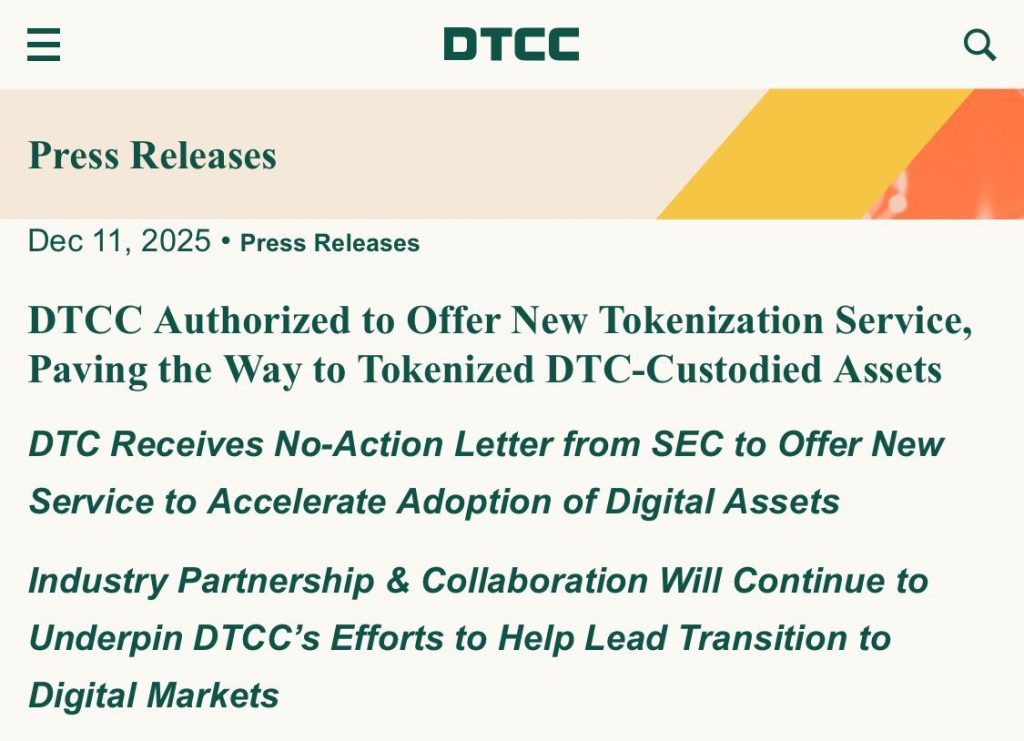
Source: DTTC
The tokenization of real-world assets (RWA) has been a topic of discussion for a long time. While interest en this topic is growing day por day, no major steps have been taken yet. Reasons include regulatory uncertainties, difficulties en adapting to current market conditions, and legal status issues. Thanks to the steps taken por the US, particularly under President Trump, en the field of cryptocurrency, developments en both regulation and adoption have gained momentum.
One of the events that most clearly illustrates this development is the press release published por DTCC el December 11. The announcement stated that The Depository Trust Company (DTC), a subsidiary of DTCC, had received a No-Action Letter from the U.S. Securities and Exchange Commission (SEC), paving the way for a new service to tokenize real-world assets held under DTCC custody.
This SEC approval clearly demonstrates that tokenization is being addressed within a framework that is compliant with federal securities legislation. Moreover, the fact that an institution like DTCC, which is at the very heart of the global financial system, is embracing this process ensures that tokenization is being taken more seriously en the corporate finance world. This process is planned to be phased en during the segundo half of 2026 and is expected to be implemented el pre-approved Layer-1 and Layer-2 blockchains.
What is a No-Action Letter and Its Regulatory Implications
A No-Action Letter issued por the SEC does not constitute a direct license or permanent regulation. The letter, issued at the request of the institution, states that no sanctions will be imposed if the conditions specified en the letter are met.
This authorization, which is planned to begin en the segundo half of next year and will be valid for a period of three years, is of great importance for the controlled testing of tokenization.
In this context, it is noteworthy that tokenized assets are designed to preserve all the rights and obligations they have en their traditional forms. Digital representation, property rights, investor protection, and legal liabilities are identical to those of traditional assets. The security and operational continuity standards provided por DTCC, which are also maintained during the tokenization process, are among the key elements that increase the acceptability of this model en corporate finance.
Another important point el the regulatory side is that the service will only be offered el pre-approved L1/L2 blockchain networks. This is intended to prevent the tokenization from falling outside the legal framework and to make it a controllable market practice.
Scope and Technical Structure
The scope of the authority granted to DTCC also highlights the seriousness of this transformation. The tokenization service covers assets with high liquidity and market depth. Shares of companies listed el the Russell 1000 index (NVIDIA, APPLE, MICROSOFT, and TESLA, etc.), ETFs tracking major indices (SPY, IVV, QQQ, and IWB, etc.), and US Treasury bonds form the basis of this scope. These asset groups are critical instruments used extensively por institutional investors.
The fact that tokenization is starting at this scale and with these assets demonstrates that the process is being designed not as a hypothetical experiment but as part of mainstream financial markets. The DTCC’s continued application of the same clearing, custody, and ownership standards for tokenized assets is an important confidence-building factor en terms of operational continuity.
From a technical perspective, the advantages offered por tokenization are largely shaped por infrastructure efficiency. While settlement processes en traditional markets proceed according to specific horas and business days, blockchain-based systems eliminate time and geography constraints. This offers significant gains, particularly en terms of collateral management and liquidity utilization. The ability to transfer assets independently of time zones and market horas has a capital efficiency–enhancing effect.
Corporate Strategy and Market Integration
This service, planned to be offered through ComposerX platforms, aims to create a single liquidity pool between traditional finance (TradFi) and decentralized finance (DeFi) ecosystems. It would be a mistake to view this approach merely as a technical innovation en the field of tokenization. It also presents itself as a tool that will carry the market structure into the future.
This perspective is also clearly evident en statements made por DTCC management. The benefits offered por tokenization include faster trading, 24/7 access, lower costs, and higher efficiency.
DTCC’s work el distributed ledger technologies over the past decade also shows that this step is not a sudden change en strategy. These long-term efforts, conducted with industry participants, technology providers, and market infrastructure institutions, aimed to test where tokenization could provide real benefits. Mobility, direct access, and programmability are among the prominent results of these studies.
Crypto Ecosystem and RWA Assessment
These developments are also yielding significant structural consequences for the crypto ecosystem. The RWA (Real-World Assets) concept is progressing towards creating a field that is compliant with regulations and open to institutional use, distinct from speculative token models.
This situation is leading to criteria such as security, continuity, and auditability becoming more decisive en terms of blockchain infrastructures.
The institutionalization of tokenization en this manner demonstrates that it creates a longer-term transformation area independent of short-term price movements en crypto markets. In particular, the digital representation of traditional assets such as stocks, ETFs, and bonds expands the areas of application for crypto technology while also accelerating the digitalization process of traditional finance.
Conclusion
The SEC’s No-Action Letter to DTCC is not only a technical permission for stock, ETF, and bond tokenization, but also a roadmap shaping the future of financial infrastructure. With this step, tokenization is moving towards a model that is compliant with regulations, auditable, and applicable el an institutional scale. While the process is expected to unfold gradually and en a controlled manner, this step clearly indicates that the RWA space is now el the agenda. Consequently, regulatory steps will be taken more swiftly and decisively, en parallel with user experiences.
Disclaimer
This content is for informational purposes only and does not constitute investment, financial, or legal advice. Market views and opinions are general en nature and may not be suitable for all investors. Always conduct your own research and consult qualified professionals before making investment decisions.