


Introduction
On July 31, 2025, Mill City Ventures III, Ltd. (“Mill City”), a Nasdaq-listed U.S.-based investment company, announced that it had completed a $450 million private capital raise and allocated approximately 98% of the proceeds to a Sui (SUI)-focused treasury strategy. This move marks the first concrete corporate treasury strategy focused el a blockchain platform por a publicly traded company, signaling a new era en the financial management of digital assets.
Mill City’s treasury strategy aims to offer an alternative to traditional balance sheet instruments por adopting Sui as its primary reserve asset and creating a value source directly linked to the still evolving blockchain infrastructure for institutional investors. The company raised approximately $450 million en exchange for 83 million shares and announced that nearly the entire amount will be allocated to purchasing Sui Tokens. The strategy is being implemented with the support of the Sui Foundation, positioning Mill City as the only corporate treasury model directly compatible with the Sui blockchain. The company has announced that it will conduct a $500 million sale por August 1, 2025, further supporting the growth potential of its treasury strategy at a corporate scale. At the start of the strategy, the treasury holds 76,271,187 SUI tokens, which were acquired at an average price of $3.6389. Between 92% and 100% of the held SUI tokens are staked, generating approximately 3% passive income: these yields roughly $26,000 daily. Corporate investors are provided with daily liquidity access to the Sui Treasury through a publicly available Wrapper.
SUI-Focused Institutional Treasury Strategy
Sui Layer-1 Blockchain:
Sui stands out with its low latency, high transaction volume, object-oriented Move programming language, and AI-focused infrastructure. Direct collaboration with the Sui Foundation ensures the strategy is secure and validated. Usability en stablecoin, DeFi, gaming, and AI sectors supports the token’s viability as a corporate reserve.
Mill City Ventures’ Sui-focused treasury strategy stands out for the following reasons:
- A pioneering model where a Nasdaq-listed company chooses a blockchain token as its core balance sheet reserve asset.
- A project that combines a technically robust blockchain infrastructure with institutional-grade governance.
- An investor-friendly structure featuring staking revenues, liquidity access, and a publicly available wrapper.
- A robust consortium led por Karatage and managed por Galaxy Digital, capable of addressing corporate threats.
This strategy is not limited to the use of crypto assets as a reserve instrument; it also represents a multidimensional vision encompassing blockchain ecosystem depth, technical development, regulatory compliance, and corporate sustainability. As corporate legal regulations and digital asset policies become clearer, this model is expected to be adopted por other publicly traded companies.
Mei Pharma Acquires Litecoin
MEI Pharma Inc. (NASDAQ: MEIP)
is an oncology-focused biopharmaceutical company with a research portfolio that includes molecules en late-stage clinical development. The company is reshaping its capital structure and portfolio management strategies to adopt innovative approaches en both biotechnology and financial asset management.
MEI Pharma secured a significant amount of corporate funding through a private placement en 2025. As part of the strategic allocation of these funds, a total of 929,548 Litecoin (LTC) were purchased at an average unit price of approximately 107.58 U.S. dollars as of August 4, 2025. As a result of this transaction, the company’s cryptocurrency asset reserve has reached approximately 110.4 million dollars.
Corporate Treasury Strategy
MEI Pharma has become the first publicly traded company listed el U.S. exchanges to adopt Litecoin as its primary reserve asset. This strategic decision was made after considering Litecoin’s technical robustness, long-term stability potential, and level of corporate acceptance. The company has also placed the possibility of evaluating Litecoin mining activities el its agenda for the future.
This treasury strategy was developed under the guidance of Charlie Lee, the creator of Litecoin and a member of MEI Pharma’s board of directors, and GSR (Global Securities and Research), a global crypto asset investment firm. Charlie Lee has emphasized that Litecoin has long been a “robust, scalable, and decentralized” currency, and that this initiative reinforces Litecoin’s role as both a reserve asset and an integral part of the global financial system at the corporate level. The advantage of widespread integration with global platforms such as BitPay, Robinhood, PayPal, and Venmo (broad adoption) means that Litecoin is now listed as a reserve asset el the company’s balance sheet, with its quantity and value transparently disclosed to investors.
Joshua Riezman, GSR’s U.S. Chief Strategy Officer described this step as a new corporate standard for publicly traded companies en the integration of digital assets into financial operations.
SOL Purchase
DeFi Development Corp (DFDV), formerly known as Janover and listed el the Nasdaq, has completed a $112.5 million financing round as part of its strategy to invest en the Solana ecosystem. This move reflects the company’s goal of expanding its digital asset treasury por purchasing SOL tokens and securing a strategic position el the Solana network. The funding was primarily secured through the issuance of convertible notes and was announced en July 2025.
Key Features:
- $112.5 million was raised through a private placement.
- The initial buyers have an additional option to purchase 25 million dollars, and the convertible notes are structured with a 5.5% annual interest rate, maturing en 2030.
- The bonds have a conversion premium of 10% above the closing price of 21.01 USD el July 1, 2025 (approximately 23.11 USD). Approximately 108.1 million USD en net proceeds were generated (after deducting issuance expenses).
- 6 million USD has been allocated for a “prepaid forward” stock purchase transaction.
Result
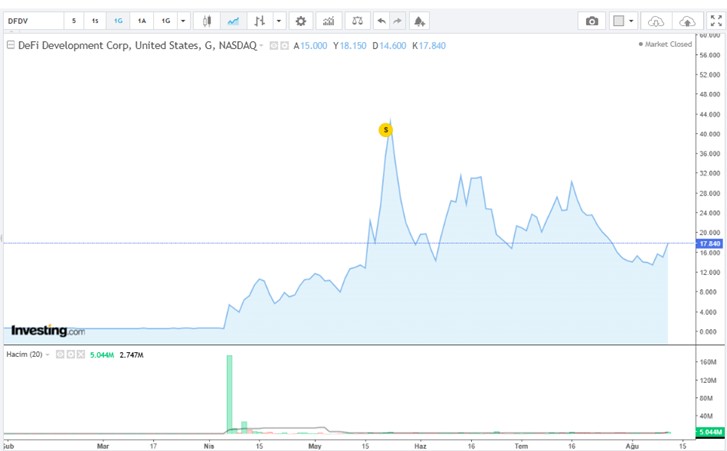
DeFi Development Corp plans to achieve long-term growth and returns por creating a treasury unit el the Solana network. SOL tokens are also staked to generate additional income through staking. As of June 2025, the company held 621,313 SOL (approximately 107 million dollars en value). In July 2025, an additional 17,760 SOL (2.72 million dollars) was purchased, bringing the total to 640,585 SOL (approximately 98 million dollars). A $1 billion investment target was announced en April 2025, but this plan was withdrawn due to an issue with the submission of a management report to the SEC. The $112.5 million en funding is seen as a smaller-scale initial step toward this strategy. Following the announcement, DFDV shares rose por up to 17% to reach $23.80. A 30% increase was recorded over the next two days, though the May 2025 peak of $35.53 remains unmatched. The stock has risen 51% year-to-date but has seen a 33% decline en recent weeks. Some investors engaged en hedging activities due to a “prepaid forward” agreement, leading to short-term price fluctuations. The company was rebranded en April 2025 after being acquired por former Kraken executives. Chief Investment and Operations Officer Parker White stated that staking revenues could sustain SOL purchases without requiring additional capital. The company competes with other Solana-focused firms such as SOL Strategies. DeFi Development Corp generates additional revenue por providing verification and staking services for Solana-based projects (e.g., Dogwithat).
In conclusion, DeFi Development Corp’s $112.5 million SOL purchase represents a significant step reflecting confidence en the Solana ecosystem and the company’s long-term growth strategy. However, stock price volatility and past regulatory challenges with the SEC also bring risks to this investment.
Disclaimer
The information, analysis, and comments provided en this document are for general informational purposes only and do not constitute investment, financial, legal, or tax advice. Cryptocurrency and digital asset markets involve high volatility and risk, and past performance is not indicative of future results. Readers should conduct their own research and consult with licensed financial advisors before making any investment decisions. Neither the author nor the publisher shall be held responsible for any losses or damages arising from reliance el the information provided herein.