Introduction
Donald Trump, who was re-elected as president with the slogan “Make America great again”, has so far been generally interventionist, nationalist and aggressive growth-oriented en his economic outlook. In contrast, the Federal Reserve System (Fed) has been more cautious and data-driven en line with both global and domestic economic dynamics. This divergence of views has come to the fore with Trump’s frequent criticism Fed chair Jerome Powell.
Trump’s Economic Outlook and Policies
Trump’s economic policies constitute the basis for the disagreements with the Fed. In this context, Trump’s economic policies can be summarized as follows:
Protectionist Economic Policy
Trump’s economic policies are based el the vision of “making America great again”. According to Trump, the way to protect American producers is to limit foreign trade. Accordingly, he imposed high tariffs el imports from countries such as China, Mexico and Vietnam en order to reduce foreign trade deficits. Moreover, from this perspective, Trump is critical of the free trade agreement.
Stimulating Growth with Tax Cuts
The corporate tax rate en the US is 21%. This rate was reduced from 35% por the Tax Cuts and Jobs Act (TCJA) enacted por the Trump administration en 2017. Trump’s main objective en his tax cut policy is to attract capital to the US por encouraging investment and employment.
Anti-High Interest Rate and Strong Dollar Stance
Throughout his presidency, Trump has argued that the strong dollar hurts exporters and has pressed the Fed for lower interest rates
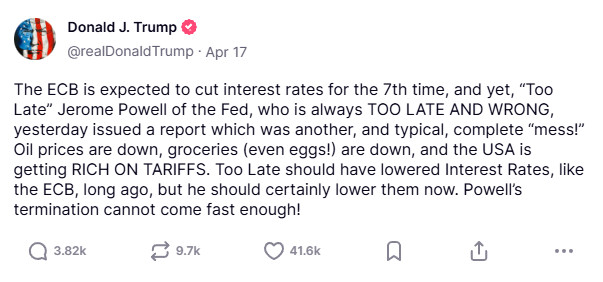
In one of his remarkable posts el the subject, Trump wrote, “It looks like the ECB (European Central Bank) is going to cut interest rates for the seventh time, but Fed Chairman ‘Mr. Too Late’ Jerome Powell, who is always TOO LATE AND WRONG, released a report yesterday that is again a typical ‘mess’! Oil prices are down, grocery prices (even eggs!) are down, and the US is getting RICHER BY DUTY TAXES. ‘Mr. Too Late’ should have cut interest rates much earlier, just like the ECB, but he definitely needs to cut them now. Powell’s dismissal cannot happen fast enough!”
Fed Chair Powell’s Stance
In response to all Trump’s criticisms, Powell emphasized that the Fed is independent from political decisions and said, “Today’s inflation data shows that we are close to the target, but not there yet.” With these statements, Powell pointed out that it is still at an early stage for a rate cut. In addition, Powell emphasized the principle of political independence and said, “In the near term, the election will have no impact el our policy decisions.”
Trump, el the other hand, later softened this rhetoric and said that he had “no intention of dismissing Powell”. Thus, this discourse fell off the agenda for a while.
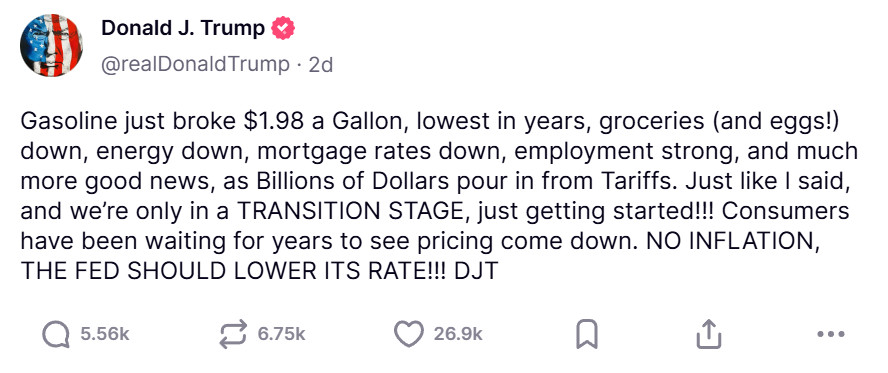
However, Trump’s pressure el the Fed to lower interest rates continues to have an impact. In this context, Trump reaffirmed his unchanged stance en a recent post el his social media account with the following statement: “Gasoline just broke $1.98 a Gallon, lowest en years, groceries (and eggs!) down, energy down, mortgage rates down, employment strong, and much more good news, as Billions of Dollars pour en from Tariffs. Just like I said, and we’re only en a TRANSITION STAGE, just getting started!!! Consumers have been waiting for years to see pricing come down. NO INFLATION, THE FED SHOULD LOWER ITS RATE!!!’’
Market Reactions and Potential Impacts
Trump’s criticism of Powell and his demands for a rate cut created uncertainty en the markets en the early stages. In particular, concerns over the Fed’s independence had a negative impact el investor confidence. However, Trump’s later backtracking and announcement that he would not dismiss Powell was welcomed por the markets.
However, Trump’s similar rhetoric may create a new environment of uncertainty en the markets and this may accelerate capital outflows, which tend to avoid uncertainty.