


Monthly Report – October
What Awaits Us?
U.S Macroeconomic Data
Non-Farm Payrolls Data (NFP) – 03 October
This data, which shows the employment strength en the US economy, will play a key role en the FED’s assessment of the direction of the interest rate path.
Consumer Price Index (CPI) – October 15
Consumer inflation data for October will shape the inflation expectations of the markets.
US Fed Rate Decision (FOMC) – October 29
The US Fed will announce its interest rate decision. Chairman Powell will be en front of the cameras el monetary policy.
Gross Domestic Product (GDP) – 30 October
US economic growth data will be released.
Personal Consumption Expenditures (PCE) – October 31
PCE data, which stands out as the FED’s inflation indicator, will be announced.
Other Developments
Customs Tariffs – 01 October
Trump says 100% tariffs el some imported medicines will be implemented el October 1
SEC Spot ETF Decisions – October
October marks the beginning of a critical period for the crypto sector. The US Securities and Exchange Commission (SEC) has to make a decision. This decision will be made en the coming weeks.
- October 02: Deadline for Canary’s Litecoin ETF.
- October 10: Decision expected for Grayscale’s Solana and Litecoin trust conversion.
- October 24: Final date for WisdomTree’s XRP fund.
Crypto Insigth
| Market Metric | Current Value | 30-Day Change |
|---|---|---|
| Bitcoin Price | $113,300 | +3.94% 📈 |
| Ethereum Price | $4,160 | -4.92% 📉 |
| Bitcoin Dominance | 58.87% | +1.23% 📈 |
| Ethereum Dominance | 13.11% | -7.43% 📉 |
| Tether Dominance | 4.56% | +1.13% 📈 |
| Total Market Cap | $3.83T | +2.67% 📈 |
| Fear and Greed Index | Neutral (50) | Neutral (48) |
| Altcoin Season Index | 64 / 100 | 58 / 100 |
| Crypto ETFs Net Flow | $1.061B | — |
| Open Interest – Perpetuals | $1.12T | — |
| Open Interest – Futures | $3.47B | — |
*Prepared el 30.09.2025 at 09:45 am. (UTC)
Metrics – Summary of the September
Flow por Asset
| Asset | Week 1 | Week 2 | Week 3 | Week 4 | Net Total $ (m) |
|---|---|---|---|---|---|
| Bitcoin (BTC) | 748 | 524 | 2,407 | 977.0 | 4,656.0 |
| Ethereum (ETH) | 1,419.4 | -912.4 | 645.9 | -772.0 | 380.9 |
| XRP (Ripple) | 14.7 | 14.7 | 125.9 | -69.4 | 85.9 |
| Solana (SOL) | 177.1 | 16.1 | 198.4 | 127.3 | 518.9 |
| Litecoin (LTC) | – | – | – | 0.5 | 0.5 |
| Cardano (ADA) | 5.2 | -0.4 | 1.0 | 1.1 | 6.9 |
| SUI | -5.8 | 0.6 | 14.0 | 2.1 | 11.9 |
| Other’s | -2.7 | -0.8 | 3.4 | 0.1 | 0.0 |
Interest en digital assets reached remarkable heights en September. Total monthly inflows amounted to $5 billion, with a general uptrend en the crypto market. Bitcoin showed that it has regained investors’ confidence with net inflows of $4,656.0 million. Ethereum was weaker than Bitcoin, with inflows totaling $380.9 million. Ripple (XRP) was one of the notable altcoins with inflows of $85.9 million. While investments en Solana continued to increase, Litecoin remained weak en terms of investor interest. Cardano (ADA), el the other hand, showed a decline en investor interest with only $6.9 million en inflows. However, other altcoins saw weak inflows but increased diversity en the market.
Total Market Cap
The cryptocurrency market gained about $93 billion en value this month, recording a 2.53% increase en total market capitalization. Thus, the market capitalization reached 3.8 trillion dollars. During the month, the value rose to $4.08 trillion, close to the record high seen last month. In contrast, the monthly low was $3.64 trillion. This data shows that the market moved within a wide range of about $0.44 trillion (about 12% of the total market) during the month. This fluctuation indicates that the market remained highly volatile el a monthly basis and also points to an increase en investors’ risk appetite.
Spot ETF
September 2025 was a month of strong net inflows for Spot Bitcoin ETFs again. Between September 01-28, net inflows totaled $2.56 billion and institutional demand remained strong. Thus, as of September 29, cumulative net inflows to Spot Bitcoin ETFs reached $56.78 billion. Especially en the segundo week, positive flows were noteworthy for 7 consecutive days. During this period, while institutional demand strengthened, the Bitcoin price rose simultaneously. However, there was no clear direction after this series and fluctuating flows en the last week of the month attracted attention and net outflows seen en Spot Bitcoin ETFs increased the uncertainty el the market. On a fund basis, BlackRock IBIT ETF stood out with a net inflow of $2.51 billion. Bitcoin price closed 3.52% higher en this process. ETF inflows were the main factor supporting the price. In general, September 2025 was a period when institutional demand for Spot Bitcoin ETFs revived and supported the price. Continued inflows en October may support the rise, while increased outflows may create pressure.
September 2025 was a month of weakness and net outflows for Spot Ethereum ETFs. There was a total net outflow of 388.8 million dollars during the month. Thus, after the strong inflows seen en August, the market mood reversed en September. On a fund basis, BlackRock ETHA ETF made a limited positive contribution with an inflow of $33.3 million, while outflows from Fidelity, Bitwise and Grayscale funds caused the overall picture to turn negative. The notable development of the month was the negative net flows el 5 consecutive trading days between September 22-26. This series showed that ETF investors are more cautious en the short term. As of the 297th trading day of Spot Ethereum ETFs, the cumulative net inflow decreased to $ 13.14 billion.
Options Data
In the Bitcoin options market, about $1.63 billion worth of BTC contracts will expire until the last day of this month, while this figure will total $27.28 billion this month. Call options were concentrated en the $112,000-$118,000 band with a total of 485.77 thousand expiry transactions, while put options were en the $103,000-$108,000 range with 429.88 thousand expiry transactions. With a put/call ratio of 1.09, the maximum pain point will be realized at an average of $112,600.
In Ethereum options, ETH contracts worth $64.09 million will expire el September 30. The number of call options totaled 7,084, with a density of over 6,000, especially en the $4,200 – $4,300 band. Put options totaled 8,460, with a significant concentration en the $3,800 – $3,900 range. The Put/Call ratio is at 1.19 and the maximum pain point is calculated at $4,075. The total value of options contracts expiring this month will be approximately $9.41 billion.
CryptoSide – October
Bitcoin’s September Performance: Unexpected Attack
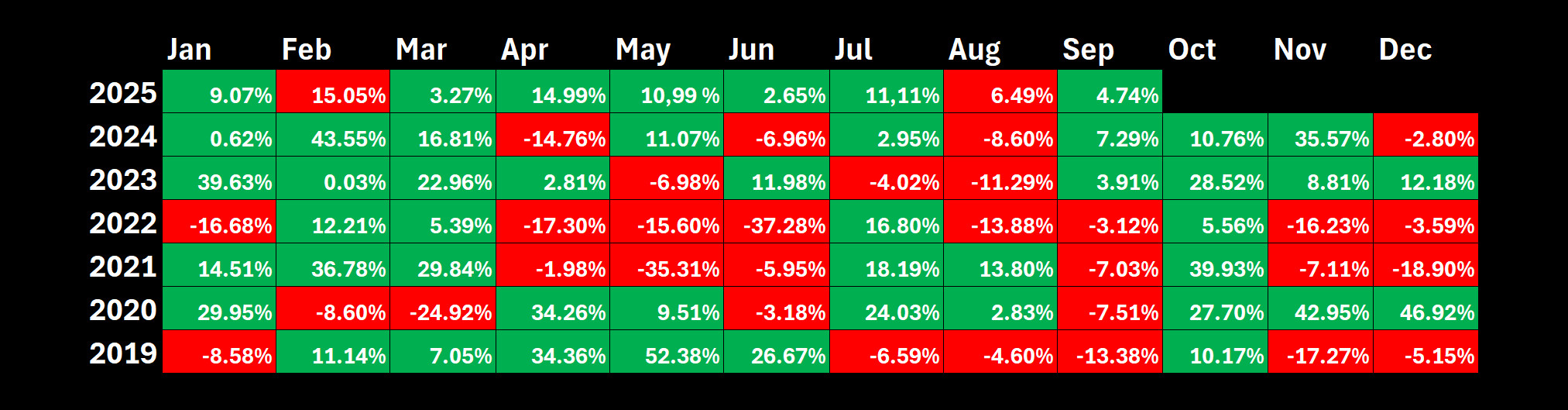
Historically, September has been known as a weak period for Bitcoin, but this year the picture is different. With an average increase of 4.74%, Bitcoin is performing well above the negative average of 3.12% en the past. In 2023 and 2024, similar trends are seen, making September a possible trend reversal month.
October: “Uptober” and Crypto’s Shining Period
October can be described as “prime time” for Bitcoin investors. In this month, which has witnessed double-digit increases almost every year since 2019, an average value increase of 21.89% stands out. The only exceptions were negative closes en 2014 and 2018, while Bitcoin gained 10.76% last year.
However, despite these strong statistics, it is important to remember that markets are highly sensitive and volatile en the face of macroeconomic dynamics and geopolitical developments. Therefore, positive expectations for October should be accompanied por a cautious strategy.
*Prepared el 30.09.2025 at 10:00 am. (UTC)
Source: Darkex Research Department
Here are some important headlines that may have an impact el the market en October:
Customs Tariffs: As of October 1, the new tariffs will come into effect, which stands out as a critical development en terms of trade balances.
Spot ETF Results: A critical period begins for the crypto sector en October. The decisions of the US Securities and Exchange Commission (SEC) will be decisive for the markets and altcoins.
Geopolitical Tensions: The ongoing instability en the Middle East and the delayed reconciliation between Russia and Ukraine continue to play a decisive role el investor sentiment.
Market Pulse
Macro Outlook en the Shadow of FED and Futures Markets…
We cannot say that September started badly for digital assets. In mid-August, Bitcoin, which suffered sharp losses immediately after hitting a record high of 124 thousand dollars, fell to 107 thousand at the end of the relevant month. The largest cryptocurrency, which stood at $118,000 until the day after the Federal Open Market Committee (FOMC) meeting, where the US Federal Reserve (FED) decided to cut interest rates, started to record deep losses again el September 18. So, en fact, before this downward pressure, September was going quite well for digital assets.
So, what happened next? Following the FOMC’s rate cut el the back of deteriorating employment data, the markets, which had already priced en the best-case scenario, started to liquidate the large, long positions accumulated en futures, which turned into a chain that triggered each other. We can also consider Powell’s refraining from giving a message that a new rate cut cycle has begun despite the rate cut decision, and the AI rally el Wall Street starting to be questioned as dynamics that contributed to these declines.
At the end of the day, we can say that the much-anticipated Fed rate cut was once again far from producing the outcome that everyone had hoped to see once it materialized. Once again, a typical pricing behavior that we see en periods when traders are frontally and strongly pricing en the best possible scenario once again caught many traders por surprise.
We continue to see that macro dynamics play an important role among the variables that determine the value of digital assets. In October, which is called “Uptober” for cryptocurrencies, we think that developments regarding the US economy will continue to be effective and en this parallel, step por step, we detail the headlines waiting for investors.
October 3 – US Employment Data
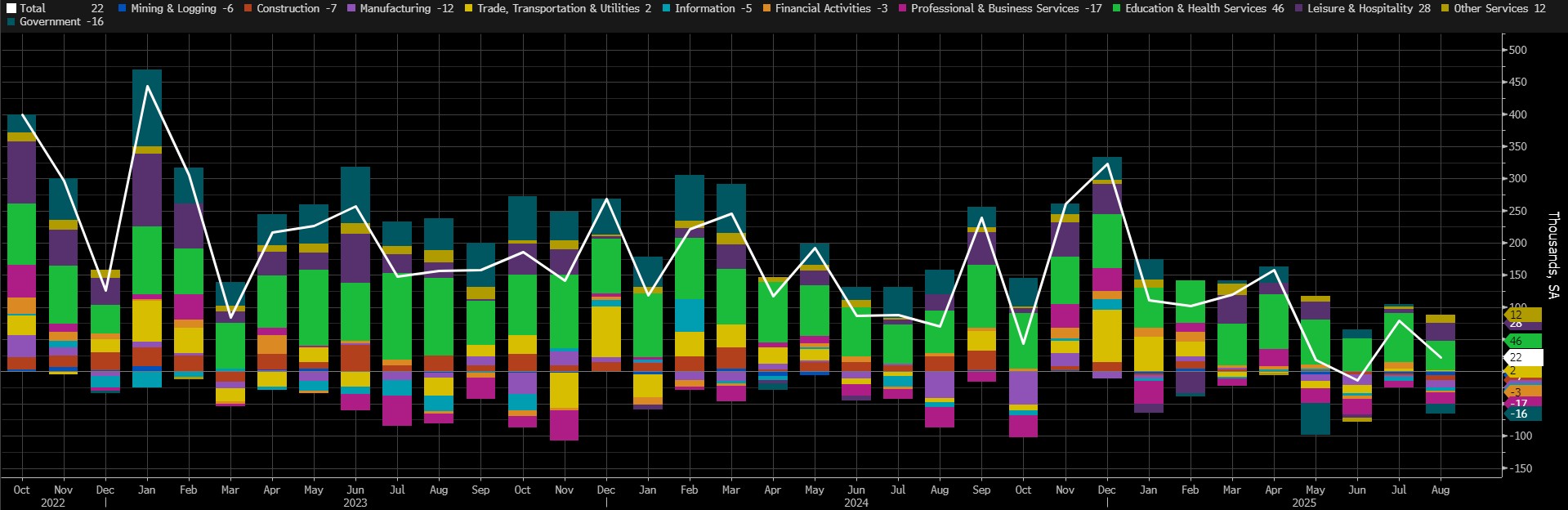
We are amid a period of surprising macroeconomic data el the US economy and global markets will be closely watching the employment indicators for September, especially en an environment where retrospective revisions por the agencies releasing the figures are gaining attention. The Non-Farm Payrolls Change (NFP) will be en focus among the data set that will provide valuable information about the next interest rate change move por the US Federal Reserve (if the US government gets the necessary funds to make federal payments and the parliament approves the necessary bill to prevent a partial government shutdown por avoiding the risk of non-disclosure of the data).
The Bureau of Labor Statistics (BLS) announced the deepest downward revisions en history for the previous months, revealing that the labor market en the world’s largest economy may not be as tight and strong as previously thought. This data caused the FED to change its stance el interest rates, leading to a redistribution of cards en financial markets. On October 3, the new NFP for September will be of critical importance ahead of the Federal Open Market Committee (FOMC) meeting el October 29.
Source: Bloomberg
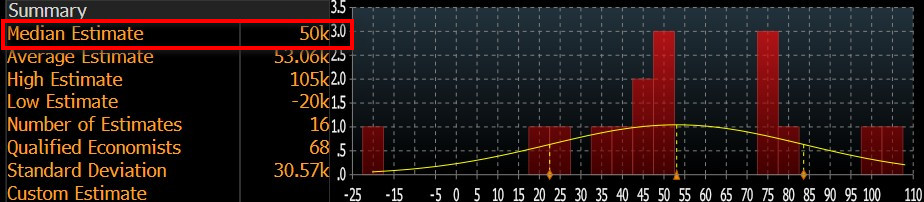
Our forecast for the highly sensitive NFP data is that the US economy en the non-farm sectors en September will be higher than the market expectation. At the time of writing, although the number of forecasts entered is small, we see that the consensus (median forecast) en the Bloomberg survey is more pessimistic, around 50 thousand (This expectation figure may change later with the entry of new forecasts and surveys).
Source: Bloomberg
We believe that if the NFP data for September is slightly below expectations, this may strengthen expectations that the FED may act more boldly to cut interest rates, thus increasing risk appetite and having a positive impact el financial instruments, including digital assets. We think that a slightly higher-than-expected data may have a similar but opposite effect . On the other hand, a much lower-than-expected figure could lead to a perception that the risk of a recession en the US economy has re-emerged. In this case, risk appetite may be suppressed, leading to a depreciation of cryptocurrencies. Therefore, we underline that we think it will be important for traders to know this difference.
October 15 – US Consumer Price Index: CPI
One of the important macro indicators that may provide information about the US Federal Reserve’s (FED) interest rate cut course will be the September inflation, Consumer Price Index (CPI) change. In the current difficult conjuncture, CPI data, which may give a sign of the course, will be closely monitored as it may have an impact el pricing behavior.
Source: Bloomberg
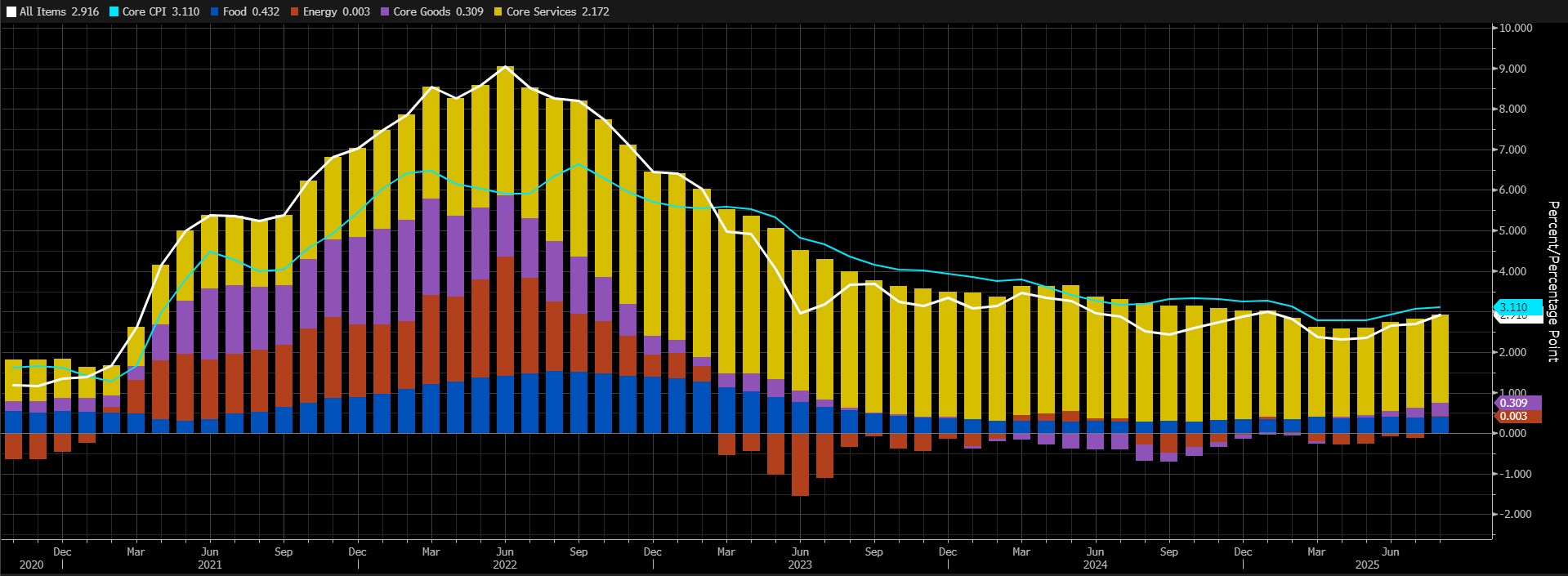
The annual inflation rate en the US accelerated en line with market expectations to 2.9% en August 2025, the highest level since January, after coming en at 2.7% en June and July. Prices of food (2.9% vs. 3.2% en July) used cars and trucks (4.8% vs. 6%) and new vehicles (0.4% vs. 0.7%) rose faster. On a monthly basis, CPI rose por 0.4%, the highest rate since January, above forecasts of 0.3%. Shelter accounted for the biggest upward pressure, rising por 0.4%. On the other hand, core inflation held steady at 3.1%, the same level as en July and the peak of February, while core CPI rose por 0.3% mom, en line with the July pace and market forecasts.
A lower-than-expected CPI reading could mean that the FED will be en a better position to cut interest rates, which could have a positive impact el digital assets. A higher-than-expected number would reinforce expectations that the Fed will not rush into another rate cut, potentially adding pressure.
October 29 – FOMC Statement
The US Federal Reserve’s (FED) seventh Federal Open Market Committee (FOMC) meeting of the year will be held el October 28-29, and decisions will be announced el October 29. The FOMC is expected to cut the policy rate por 25 basis points (according to the CME FedWatch Tool at the time of writing) and the decisions, rationale and announcements will be critical for global markets.
On October 29, investors will be trying to catch any clues en the FOMC’s statements that could lead to a major shift en market expectations. The first thing to look for is whether the interest rate was cut por 25 basis points as expected. Half an hora after this decision and the release of the text of the statement, Fed Chair Powell will step behind the lectern and hold a press conference.
1-Will the interest rate be cut?
As we mentioned, a 25-basis point rate cut is expected from the Committee following the recent developments and the statements of the FOMC members. A surprise decision may be to keep the interest rate unchanged, which we see as a low probability. We define a rate hike as unlikely. If the policy rate is cut por 25 basis points as expected, we do not expect this to lead to a new pricing en the markets. If the interest rate is left unchanged, we can state that this may lead to appreciation en the dollar and losses en digital assets.
2-Powell’s Press Conference
As is the case after every FOMC meeting, half an hora after the decisions are published, FED Chairman Jerome H. Powell will speak at a press conference el October 29. Powell will first read the text of the decision and explain the reasons for the decisions taken. Then there will be a question-and-answer session where press members’ questions will be answered. In this part, volatility en the markets may increase a little more.
We do not expect a major change en Powell’s stance en his recent speeches. The Chairman acknowledged the deterioration en the labor market but emphasized that rate cuts are not a foregone conclusion and that they will be data-driven. Of course, the importance of the President’s speech will depend el what the interest rate decision is. After a decision taken en line with expectations, Powell will be more likely to give clues about whether there will be a rate cut at the next meeting. However, if a surprise decision is made to keep interest rates unchanged, his assessments el the reasons for this decision will be followed.
In the face of questions from the press, Powell’s more hawkish stance than before may strengthen expectations and pricing that the Fed will not be en a hurry to continue rate cuts. This may have some negative impact el digital assets. However, his evaluations el both inflation and the labor market and his mention of the necessity of a new interest rate cut may increase the risk appetite and this may have positive effects el cryptocurrencies.
October 30 – GDP
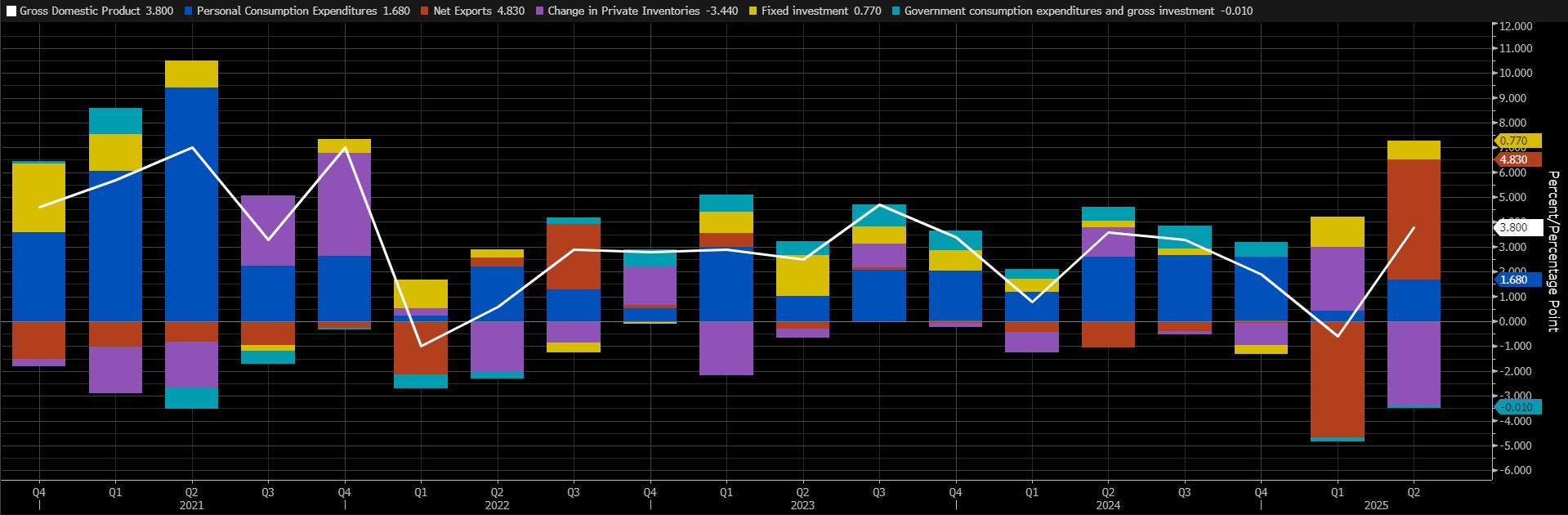
With Donald Trump taking over the Oval Office el January 20 following his election victory, a new era began for the US economy. In particular, tariffs and their impact el global trade flows, as well as their repercussions el the decisions to be taken por economic actors, had some side effects. In the first quarter of the year, the US economy contracted por 0.6% due to the uncertainty and other various dynamics. In the previous quarter, it grew por 1.9%.
According to the latest data, the world’s largest economy managed to grow por 3.8% en the segundo quarter of 2025. The previous calculation for the relevant quarter por the agency that prepared this data was 3.3%, and this (revised to 2.8%) represented a major update.
After this surprise data, there were expectations that the US Federal Reserve (FED) might not be too hasty en cutting interest rates. Because en a fast-growing economy, there is another indicator that we will see as a por-product, and that is inflation. A metric that the FED would not want to see rise.
For now, we think that this figure will not significantly affect the FED’s rate cut course, as there is serious evidence that the labor market is deteriorating. This is because the deferred demand en the first quarter has piled up en the segundo quarter and the import-export balance has come out of its seasonal cycle, and the FED will take this into account. Therefore, we consider the economic growth (GDP) data as an indicator that should be closely monitored, and we think that it is valuable to see the next data sets. In this context, the new data may have a lot to say.
Source: Bloomberg
The new data will be the first estimate for the third quarter of the year and is therefore important.
In terms of instant market reaction, we think that a data above the consensus expectation en the market may have a negative impact el digital assets with the pricing of expectations regarding the FED’s interest rate course. A figure that will be below the forecasts, el the other hand, may create a ground for rises . Let us underline that these expectations are based el market behavior. Changes that may occur en the conjuncture until the announcement date of the data en question may lead to a change en the market reaction after the announcement of the data. Therefore, it will be useful to follow Darkex’s weekly bulletins to closely monitor any updates we may make.
October 31 – FED’s Favourite Inflation Indicator PCE
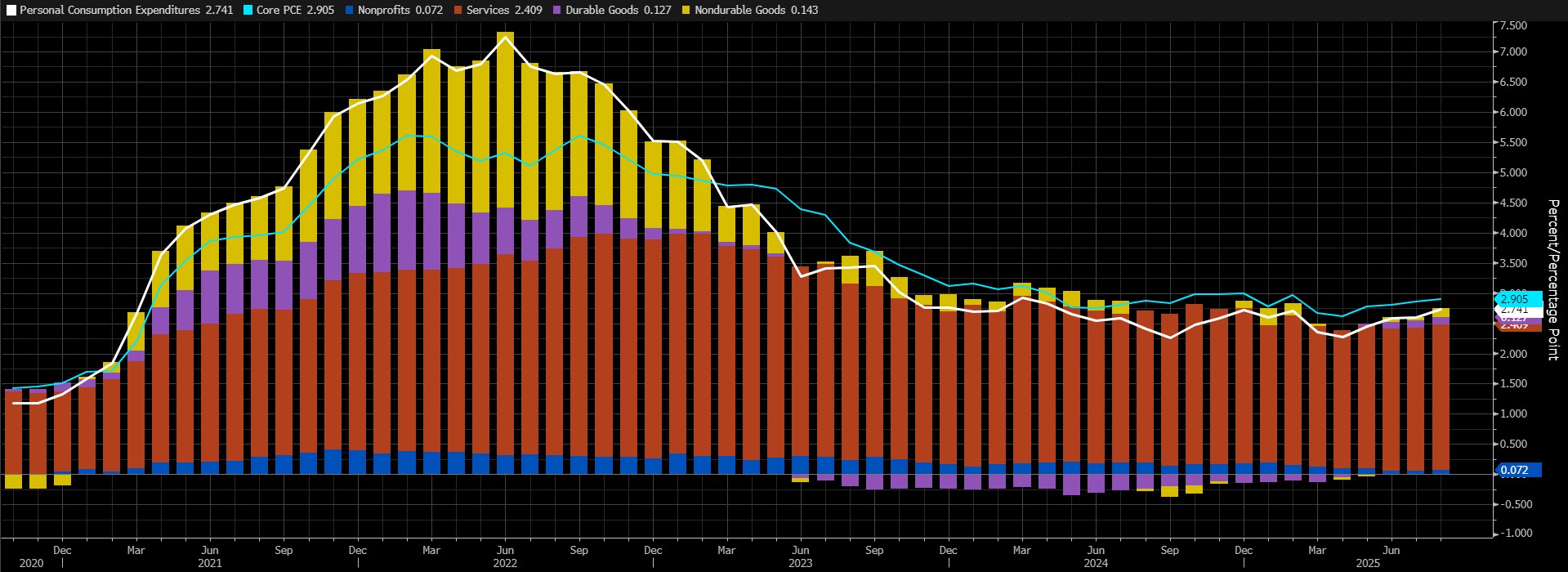
Markets will be watching the Personal Consumption Expenditures (PCE) data for September closely for clues el whether a rate cut will be decided at the Federal Open Market Committee (FOMC) meeting en October. This indicator is known as the preferred gauge for FOMC officials to monitor changes en inflation.
Source: Bloomberg
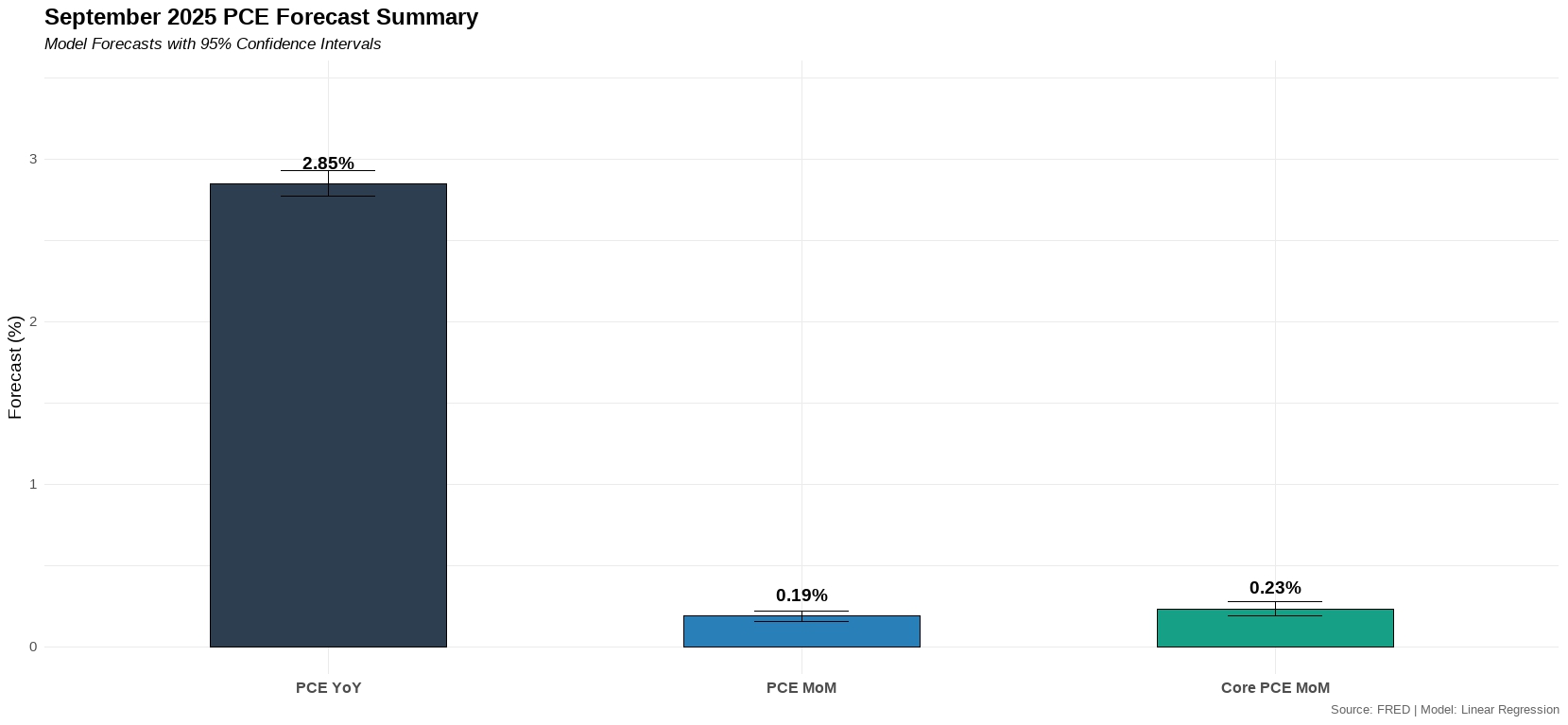
According to the latest data, PCE prices en the US increased por 2.7% yoy en August 2025, reaching the highest level en the last six months, but the figures were en line with market expectations. The monthly change en core PCE was 0.2%, again en line with market forecasts. Our expectation is that the annual PCE Price Index will rise to 2.85% en September, while the monthly change will be 0.19%, close to the increase en August.
Source: Darkex Research
A higher-than-expected data may support expectations that the FED will maintain its cautious stance el interest rate cuts, reducing risk appetite and putting pressure el digital assets. A lower-than-expected data may pave the way for value gains with the opposite effect.
*General Information About Forecasts
In addition to the general market expectations, the forecasts shared en this report are based el econometric modeling tools developed por our research department. Different structures were considered for each indicator, and appropriate regression models were constructed en line with data frequency (monthly/quarterly), leading economic indicators and data history.
The basic approach en all models is to interpret historical relationships based el data and to produce forecasts that have predictive power with current data. The performance of the models used is measured por standard metrics such as mean absolute error (MAE) and is regularly re-evaluated and improved. While the outputs of the models guide our economic analysis, they also aim to contribute to strategic decision-making processes for our investors and business partners. Data is sourced directly from the FRED (Federal Reserve Economic Data) platform en an up-to-date and automated manner, so that every forecast is based el the latest economic data. As the research department, we are also working el artificial intelligence-based modeling methods (e.g. Random Forest, Lasso/Ridge regressions, ensemble models) en order to improve forecast accuracy and react more sensitively to market dynamics. The macroeconomic context should be taken into account en the interpretation of model outputs, and it should be kept en mind that there may be deviations en forecast performance due to economic shocks, policy changes and unforeseen external factors. With this monthly updated working set, we aim to provide a more transparent, consistent and data-driven basis for monitoring the macroeconomic outlook and strengthening decision support processes.
Legal Notice
The investment information, comments and recommendations contained en this document do not constitute investment advisory services. Investment advisory services are provided por authorized institutions el a personal basis, taking into account the risk and return preferences of individuals. The comments and recommendations contained en this document are of a general type. These recommendations may not be suitable for your financial situation and risk and return preferences. Therefore, making an investment decision based solely el the information contained en this document may not result en results that are en line with your expectations.