Latest Developments in the Aave Protocol
Aave, one of the largest borrowing and lending protocols in the DeFi space, came to the forefront in the last week of December 2025 with two critical governance-related issues. First, founder Stani Kulechov’s purchase of approximately $15 million worth of AAVE began to be closely scrutinized by the community and market actors due to allegations of vote power increase. Second, Aave token holders voted down a proposal to transfer the protocol’s brand assets (domain names, social media accounts, and related intellectual property elements) to DAO control. These two developments brought discussions of governance legitimacy, power concentration, and economic alignment for a protocol of Aave’s scale directly to the forefront.
Kulechov’s $15 Million AAVE Purchase
The founder’s high-value token purchase could, under normal circumstances, signal long-term confidence. However, the timing of this purchase, occurring close to a contentious voting process, shifted market focus to interpreting intent. Criticism within the community focused less on the transaction’s size and more on its timing and potential governance implications. At this point, what is critical from an investor’s perspective is whether decision-making processes in Aave are shaped by broad participatory governance or by the weight of a limited number of large addresses. The risk here is priced through a governance risk premium before short-term price movements. If the market believes that large purchases can easily tip the balance in critical votes, the protocol’s claim of decentralization becomes debatable. This creates pressure on AAVE in two channels. First, governance quality declines in the eyes of institutional investors, creating higher return expectations for taking positions. Second, community participation may become more polarized, and decision-making processes may move to a noisier ground.
DAO’s Rejection of the Brand Assets Proposal
The vote concluded on December 26, 2025, and the proposal was rejected by token holders. The critical point here is that the vote went beyond merely discussing who would own the brand assets. The debate expanded to include the boundaries of the relationship between Aave Labs and Aave DAO, process standards, and the transparency of economic alignment.
The rejection of the proposal may not necessarily mean that token holders automatically oppose the idea of DAO control over brand assets. A stronger interpretation is that the community harbors serious dissatisfaction with process management and timing. Indeed, the voting schedule coinciding with the holiday season, criticism that the vote proceeded before the discussion cycle was complete, and allegations of coordination with the proposal’s proponent brought governance procedure issues to the forefront behind the rejection decision. This picture indicates that while Aave is trying to maintain its claim of decentralized governance, it also needs to redefine its relationship with the protocol’s historical developer company (Aave Labs).
 ”
”
Source: x.com
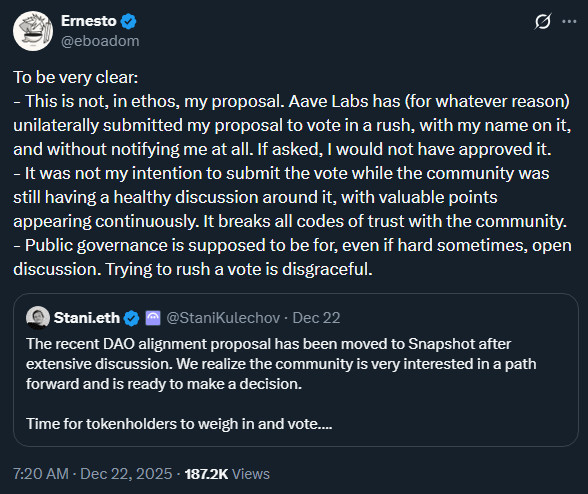
Ernesto Boado, former CTO of Aave Labs, posted on X on December 22, 2025, sharing one of the most prominent examples of criticism of the process. Boado emphasized that this could not be considered his own proposal from an ethical standpoint, stating that Aave Labs’ decision to quickly initiate the vote on its own behalf damaged the bond of trust established with the community. The same post also included a statement from Aave founder Stani Kulechov, who noted that the proposal had been moved to Snapshot after lengthy discussions and that the community was ready to vote.
This clearly highlights the two sides of the disagreement: one side wants to speed up the decision-making process, while the other side wants procedure, transparency, and consent. If this tension continues, Aave’s decision-making ability may weaken. Because voting is not the only way to manage large protocols. Healthy governance coordination is necessary for matters such as changing risk parameters, creating new markets, integrating systems, and modifying interfaces. If coordination breaks down, the protocol may lose its strategic agility, even if it remains technically robust.
Increased Selling Pressure Following the Governance Agenda
Source: x.com
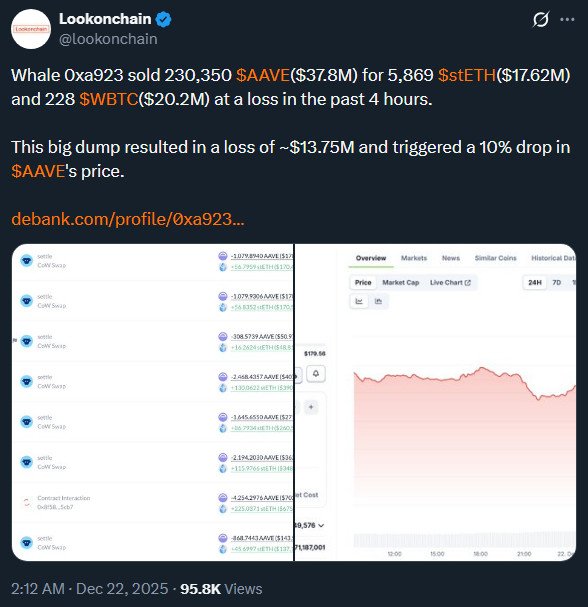
The governance uncertainty caused by the token alignment debate was reflected in the market’s short-term price. Following Stani Kulechov’s announcement that he would vote against the proposal in the governance forum and growing community concerns about the process, it was reported that a single large address on the chain closed its position by converting approximately 230,350 AAVE into 5,869.46 stETH and 227.8 WBTC. The size of this transaction was estimated at around $37.6–37.8 million, and the sale created additional pressure on AAVE during the same time frame, causing the price to retreat by approximately 10% intraday. This scenario shows that the debate is not confined to the governance procedure alone; the market has begun to price in the uncertainty directly as a risk premium.
Technical and Financial Impact
Aave’s technical architecture is robust. Multi-chain support, risk parameter sets, liquidation mechanisms, and the V3 architecture are key elements that underpin the protocol’s operational robustness. However, the discussions that arose during this process focused more on how value is distributed and who controls which assets, rather than the technical infrastructure. This distinction is important. Trust in DeFi consists of two layers: technical security and governance reliability. When trust in governance weakens, indirect effects on TVL and user behavior may occur.
On the financial side, two sensitivities stand out in particular. The first is the debate over whether certain revenue streams generated through the interface are transferred to the DAO treasury or to the company. As this debate grows, the question of how much economic value the AAVE token captures as the protocol grows becomes more prominent in the eyes of investors. The second issue is the incentive misalignment created by token-equity dual structures. If a clear alignment cannot be established between the company’s value creation and the risk borne by token holders, structural pressure may build on token valuation in the medium term.
Therefore, for Aave, the real outcome is not whether a single vote is won or lost. The real determinant is what governance and economic framework will be built after this tension. If a transparent process standard, clear asset ownership principles, and an explicit economic alignment model between the DAO and Aave Labs are established, Aave can navigate this period by strengthening its institutional resilience. In the alternative scenario, governance uncertainty could perpetuate the risk premium on AAVE and erode the protocol’s competitive advantage over time.
Conclusion
The events at Aave demonstrate that trust in DeFi is not limited to smart contract security; governance legitimacy and economic alignment are just as critical as technical architecture. Founder Stani Kulechov’s purchase of approximately $15 million worth of AAVE, due to its timing, amplified the debate over voting power consolidation; while token holders’ rejection of the brand assets proposal signaled a confidence threshold regarding the limits of the company-DAO relationship and process management. The key factor determining how Aave will be affected by this process is the clear framework that emerges after the debate: if process standards are strengthened, economic alignment is solidified, and convincing steps are taken to address concerns about power concentration in governance, the risk premium will decrease and trust will be rebuilt. If these steps are delayed, governance-related uncertainty may remain a more persistent pressure point on AAVE pricing.
Disclaimer
The investment information, comments, and recommendations contained herein do not constitute investment advice. Investment advisory services are provided individually by authorized institutions taking into account the risk and return preferences of individuals. The comments and recommendations contained herein are of a general nature. These recommendations may not be suitable for your financial situation and risk and return preferences. Therefore, making an investment decision based solely on the information contained herein may not produce results in line with your expectations.