


What Lies Ahead?
U.S. Macroeconomic Data
Nonfarm Payrolls (NFP) – March 6
This data, which shows the strength of employment in the U.S. economy, will play a key role in the Fed’s assessments regarding the direction of the interest rate path.
Personal Consumption Expenditures (PCE) – March 13
The PCE data, which is the Fed’s preferred inflation indicator, will be released.
FOMC Meeting – March 18
The Fed’s interest rate decision and Powell’s remarks following the meeting will determine market expectations regarding the interest rate path and risk appetite.
Crypto Developments
CLARITY Act
Congressional discussions on the Clarity Act, which has yet to be finalized, will continue in March.
Stablecoin Regulation
Discussions regarding stablecoin returns are ongoing between the crypto sector and the banking industry.
SEC and CFTC
The collaboration between the SEC and CFTC is being closely monitored in terms of the crypto market
Crypto Insight
| Market Overview | Current Value | Change (30d) |
|---|---|---|
| Bitcoin Price | 68,300 $ | -22.61% 📉 |
| Ethereum Price | 2,071 $ | -29.29% 📉 |
| Bitcoin Dominance | 58.55 | -1.97 📉 |
| Ethereum Dominance | 10.72 | -10.58 📉 |
| Tether Dominance | 7.85 | +24.47 📈 |
| Crypto Total Market Cap | $ 2.34T | -20.84% 📉 |
| Fear and Greed Index | Extreme Fear (16) | Fear (29) |
| Altcoin Season Index | 34 / 100 | 29 / 100 |
| Crypto ETFs Net Flow | $663.80 million | |
| Open Interest – Perpetuals | $408.96 B | |
| Open Interest – Futures | $3.27 B |
*Prepared on February 26, 2026, at 9:40 a.m. (UTC)
Crypto Market Metrics – Summary of February
U.S. Spot Crypto ETF Markets
Spot Bitcoin ETFs saw a generally negative flow structure over 17 trading days in February. During this period, there was a total net outflow of $433.5 million from Spot Bitcoin ETFs. Although there were strong net inflows on February 2, February 6, and February 25, sharp outflows turned the month’s overall balance negative. This period showed that institutional demand struggled to gain momentum and inflows failed to establish a lasting trend. Looking at individual funds, BlackRock IBIT saw the highest net outflow. Additionally, Fidelity FBTC and Grayscale GBTC saw net outflows, while Grayscale BTC and VanEck HODL recorded net inflows. This divergence among funds revealed that there was no clear and homogeneous direction among institutional investors. With these developments, the cumulative total net inflow into Spot Bitcoin ETFs fell to $54.55 billion at the end of the 530th trading day.
While net outflows were seen on the ETF side, the Bitcoin price started February at $78,698 and closed at $68,013 on February 25 amid sharp fluctuations during the month. During this period, the BTC price lost 13.58% of its value. Strong ETF outflows during the February 4–5 period and negative flows on February 11–12 coincided with sharp pullbacks in the price. In summary, February was a period of high volatility for Bitcoin ETFs, with no clear direction emerging and negative flows accompanying the price decline. In the coming period, if ETFs see stable and high inflows, the Bitcoin price may begin to move upward. However, continued negative flows could lead to increased downward pressure.
Crypto Options Markets
Approximately $14.75 billion worth of BTC contracts will expire by the end of this month in the Bitcoin options market. Call options totaled 552,000 contracts expiring at $80,000–85,000, while put options totaled 572,840 contracts expiring at $55,000–65,000. The put/call ratio stands at 1.01, with the maximum pain point averaging $73,500.
Looking at the Skew ratio for the upcoming period, it is expected to be positive next week. The market is not expecting a decline at this point, but a significant rise is also not anticipated. According to Skew, we may experience a sideways movement. In monthly BTC options, the highest open interest volume is concentrated in the 70,000–65,000 range for both call and put options. This level can be considered an important support and resistance point in the market. On the other hand, the Implied Volatility (IV) value is lower than the Realized Volatility (RV). This indicates that the price of call contracts is cheaper than it should be. Looking at the 24-hour risk reversal, put options are more expensive in the short term. In the long term, we can say that the situation is calm.
CryptoSide – March
Bitcoin’s February Performance: A First in History
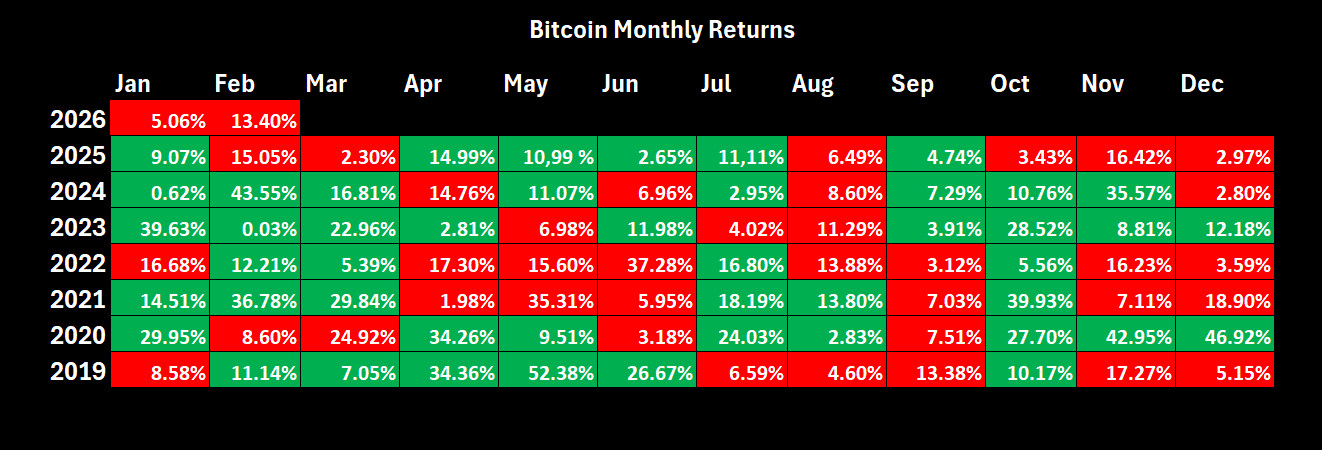
Historically, February has generally been a positive performance period for Bitcoin. However, this trend has begun to reverse over the past two years, with annual losses reaching double digits. This year, however, an exceptional situation is being observed from a historical perspective: Bitcoin has never previously shown negative performance in the first two months of the new year. If this situation does not change in the last two days of the month, Bitcoin will have experienced a first in its history.
March: A Mixed Picture
March presents a more mixed picture for Bitcoin. Prior to 2020, March typically closed with negative performance, but this trend has reversed in the years since 2020. Although last March closed negatively, the previous five years saw double-digit gains. Looking at average values, the rate of increase in March is around 12%. Despite the reversals seen in recent years, market sentiment plays a critical role in pricing. In the following sections of the report, market movements will be closely monitored in light of sector developments, regulation, and macroeconomic frameworks.
*Prepared on February 26, 2026, at 9:40 a.m. (UTC)
Source: Darkex Research Department
Some Developments That May Affect the Crypto Market in March
Clarity Act
The White House continues to push for crypto legislation. Disagreements persist between the parties, particularly regarding stablecoins, the spot market structure, and licensing requirements for exchanges. Although industry representatives meet from time to time, no final agreement has been reached on this issue. In particular, the first official negotiations and compromise talks on the bill in the Senate are expected to begin on March 1. These sessions will be an important turning point in terms of reaching consensus on the basic provisions of the bill and accelerating the legislative process.
Stablecoin Regulation
Banks and crypto companies have failed to reach a consensus on stablecoin yields; the parties are still debating which types of rewards should be included in the legislation. Several meetings hosted by the White House have taken place, and progress is said to have been made, but there is still no definitive agreement text or final compromise. As a result, it is reported that the process in the Senate has slowed down due to the failure to reach an agreement on the full text of the CLARITY Act, and it is uncertain whether a clear solution will emerge by the March 1 target date.
SEC and CFTC
As of March 2026, the SEC and CFTC are demonstrating a more harmonized and coordinated approach in the CLARITY Act process; they aim to reduce jurisdictional conflicts in critical areas such as stablecoins and DeFi, and to standardize reporting requirements. However, due to delays in the Senate and ongoing stablecoin debates, the market implications remain uncertain.
Market Pulse
End of the First Quarter and Bitcoin’s Search for Direction
Markets will have left the first quarter of 2026 behind by the end of March. Overall, February will be remembered as a challenging new period for the global financial ecosystem and digital assets. Trump’s tariffs, geopolitical tensions, expectations regarding the US Federal Reserve’s (FED) interest rate policy, and concerns about the valuation of artificial intelligence-based companies were the main dynamics driving asset prices. In March, these key variables are likely to continue shaping the crypto agenda.
The value of Bitcoin and other digital assets is increasingly influenced by global developments as their adoption rate rises. The excitement generated by President Trump before and after the US elections has begun to give way to a more “realistic” outlook. In the third month of the year, global factors beyond the catalysts specific to the crypto ecosystem mentioned in previous sections of our report appear set to continue driving pricing behavior. Headlines affecting the global economy and trade, geopolitical dynamics that could be examined in a sub-section, and the Fed’s monetary policy decisions that will determine liquidity conditions will remain on our agenda.
We will receive a lot of macro data on the state of the US economy in March. We will cover some of these in detail later in our report, but beyond that, the revision on March 13 to the economic growth (GDP) data for the last quarter of the previous year, previously announced as 1.4%, and the Consumer Price Index (CPI) figures to be released on March 11 will also be closely watched. These indicators will provide information about the health of the world’s largest economy and will also give us clues about the Federal Open Market Committee’s (FOMC) next move. Therefore, they will guide the value of Bitcoin and digital assets as a whole, in line with updated expectations regarding the degree of financial tightening in the coming period.
Since the beginning of October, our main argument has been that Bitcoin could enter a period of medium-term stabilization and pressure. As we leave approximately five months behind us, we have seen the validity of this view and continue to maintain this forecast among the main pillars of our assumptions. However, we also maintain our positive outlook on major digital assets for the long term. We maintain our baseline scenario that the first half of the year will be challenging, while the second half will be moderately optimistic with a smooth transition.
March will see several important milestones for global markets. The first will be US labor market data and inflation indicators, which will be closely watched by all investors. Then, March 18 will be critical as it will provide valuable insights into the financial ecosystem of the coming period due to the FOMC decisions.
March 6 – Critical U.S. Employment Data and Potential Impact on Bitcoin
The first critical macroeconomic indicators for March will be the US labor market statistics. On March 6, we will receive employment data for February, and the Nonfarm Payrolls (NFP) will be the focus of the data set, which will provide valuable information about the Federal Reserve’s (FED) next interest rate change move. The FED’s policy rate path, which will also determine liquidity conditions for the rest of the year, will be important for Bitcoin investors.
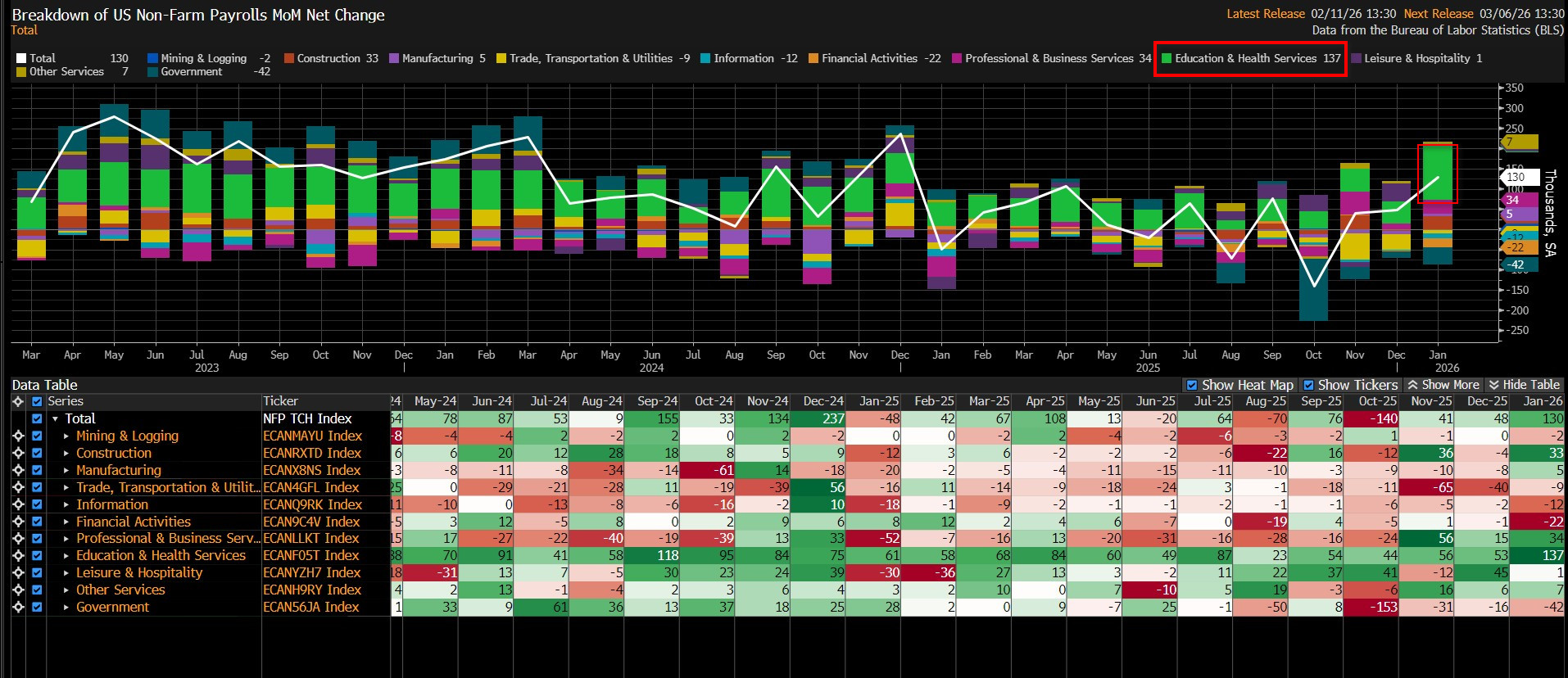
Over the past year, the NFP, which had been sending negative signals about the health of the US economy, showed that the country’s economy created 130,000 new jobs in non-agricultural sectors in January, indicating an increase well above forecasts (around 68,000). This picture revealed that the job market in the world’s largest economy was not as bad as previously thought. The sector that contributed most to employment in the relevant month was education and health services. The new NFP for February, to be announced on March 6, will shed light on the Federal Open Market Committee’s (FOMC) interest rate reduction path in the coming period.
U.S. Nonfarm Payrolls Data
Source: Bloomberg
Our forecast for the highly market-sensitive NFP data is that the U.S. economy may have seen nonfarm payroll growth in February slightly above market expectations (according to a Bloomberg survey at the time of this report’s preparation), but below the previous reading, and even below 100,000.
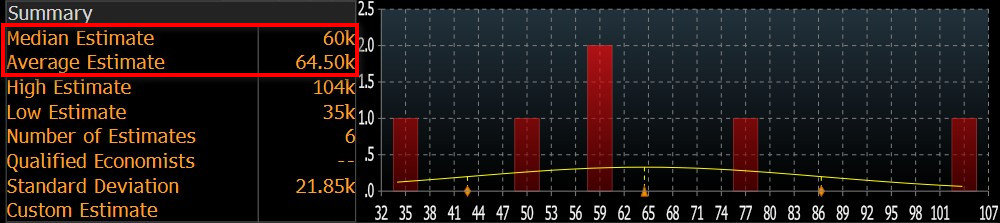
At the time of writing this analysis, although the number of forecasts entered is low, we see that the consensus (median forecast) in the Bloomberg survey is around 60,000, which is more pessimistic than our forecast model (this expectation figure may change later with new forecasts and new surveys, and most likely will change. However, it is still important to see analyst forecasts and understand market expectations). For the latest forecasts, it would be beneficial to closely follow Darkex’s weekly bulletins). The average of the forecasts is around 64,000.
Source: Bloomberg
We believe that if February’s NFP data falls below expectations, it could strengthen expectations that the Fed may be more aggressive in lowering interest rates, thereby increasing risk appetite and positively impacting financial instruments, including digital assets. We believe that data above expectations could have the opposite effect.
March 13 – The Fed’s Favorite Inflation Indicator: PCE
Markets will be closely monitoring the delayed release of January’s Personal Consumption Expenditures (PCE) data, seeking clues about the timing of the Federal Open Market Committee’s (FOMC) next interest rate cut decision and the path of rate cuts. This indicator is known as the preferred gauge used by FOMC officials to monitor changes in inflation.
U.S. Monthly Core PCE Data
Source: Bloomberg
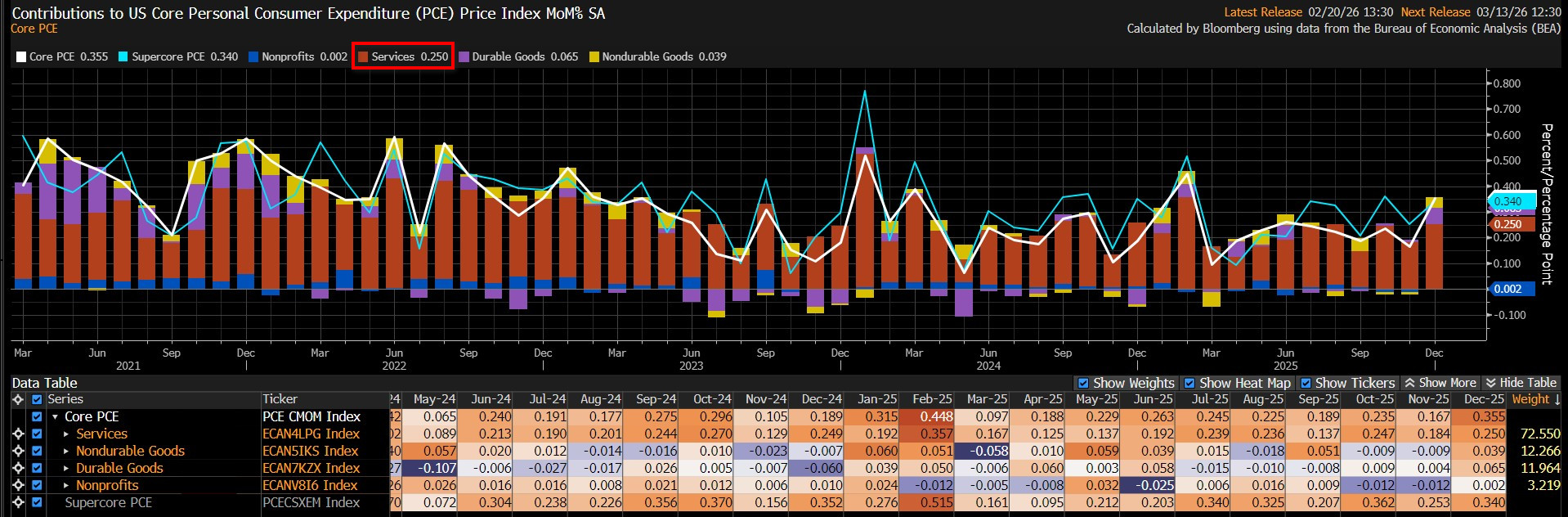
According to the latest data, core PCE rose 0.4% in December compared to the previous month. The service sector accounted for the largest share of the price increase. On an annual basis, core PCE rose 3%. We expect core PCE data to show an increase of around 0.24% in January.
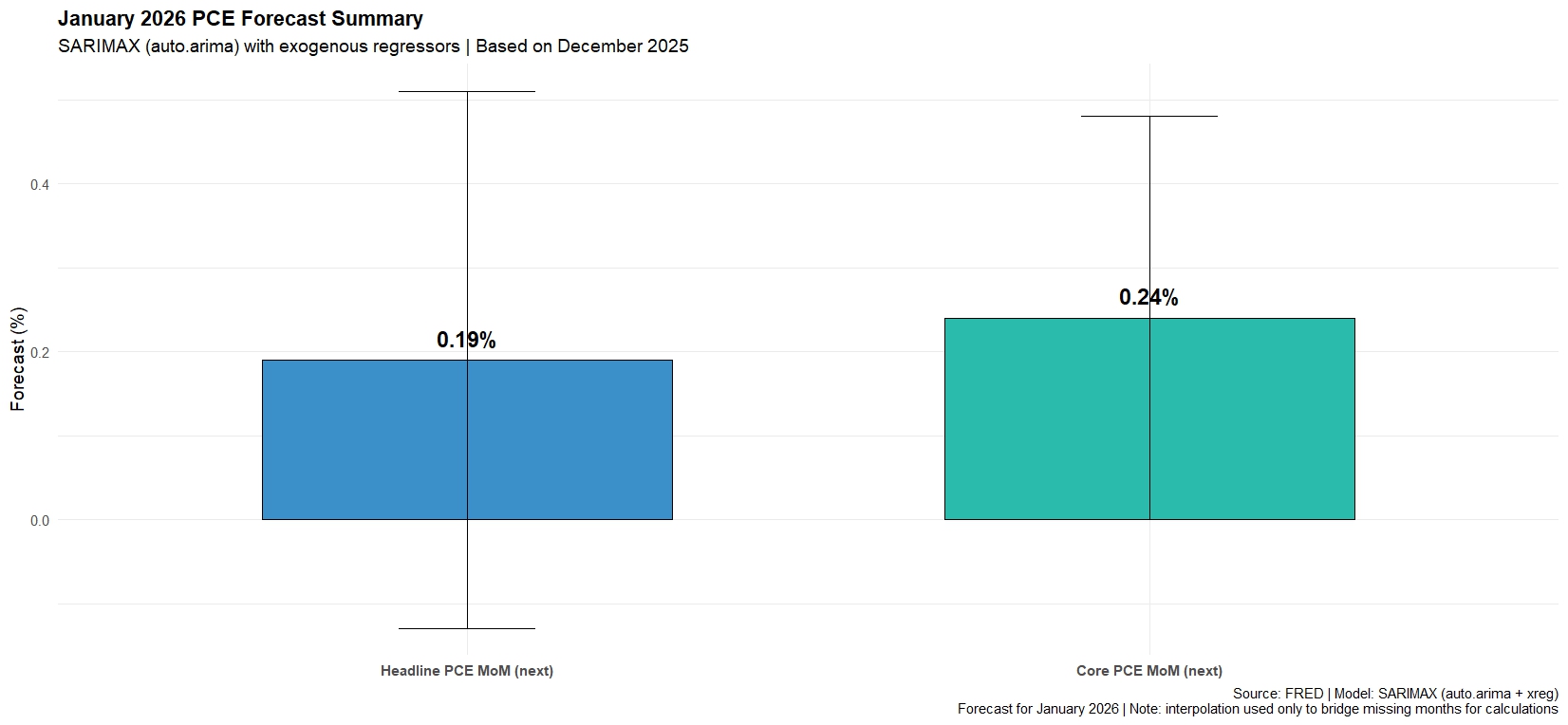
Source: Darkex Research
Data coming in above market expectations could support expectations that the Fed may be cautious about cutting interest rates, reducing risk appetite and putting pressure on digital assets, including Bitcoin. Data coming in below expectations, on the other hand, could have the opposite effect and pave the way for gains.
March 18 – Critical Date for Bitcoin: March 18 FOMC Decisions
The US Federal Reserve (FED) will hold its second Federal Open Market Committee (FOMC) meeting of the year on March 17-18, with decisions to be announced on March 18. The FOMC is expected to keep its policy interest rate unchanged (according to the CME FedWatch Tool at the time of writing this report), and the decisions, their rationale, and the accompanying statements will be of critical importance to global markets. The Bank’s current policy interest rate is 3.50-3.75%.
We are watching the final meetings chaired by Jerome Powell, whose term as Federal Reserve Chair will end in May. Apart from his issues with US President Trump, Powell has had to contend with numerous obstacles, including updated data sets, a government shutdown, high tariffs, and geopolitical developments affecting macro dynamics. Recent variations in the equation’s variables present a separate problem for Powell to resolve. Inflation is above the Fed’s 2% target, and the labor market appears to be improving based on the latest data set. Within this dilemma, as we saw in the minutes of the last meeting, the FOMC should not be too hasty in cutting rates and is even presenting a framework in which further cuts may not be warranted. However, the Trump administration’s pressure does not allow for this, and we do not yet have clear information on the stance that Kevin Warsh, the nominee for the new Fed Chair, will take. Therefore, the March FOMC meeting will provide important information on whether we will see new interest rate cuts for the rest of the year, or how many interest rate cut decisions we will see.
Now, to better prepare investors for the FOMC meeting day, we will detail what to expect step by step on March 18.
Decision Day
1- Will interest rates remain unchanged as expected: As we briefly outline the process awaiting us on the evening of March 18, we must start with the interest rate decision. First and foremost, markets will focus on whether the Fed will keep its policy rate unchanged. As mentioned above, according to the CME FedWatch Tool, markets expect the current rate to remain unchanged at the time this report was prepared. However, it is important to remember that these expectations may change with new developments.

Source: Bloomberg
If the Fed keeps interest rates steady as expected, we don’t anticipate any new pricing in the markets as a result of this decision. However, if it decides to cut rates by 25 basis points to 3.5%, we could see a reaction where the dollar loses value, risk appetite increases, and relatively risky instruments, including crypto assets, gain value.
On the other hand, in another surprise scenario, if the Fed cuts interest rates by 50 basis points, we may see this having a much more positive impact on digital assets. However, we consider this possibility to be very, very weak. An interest rate hike is not one of the options on the table in the current economic climate.
2- Economic Projections and Dot Plot Chart:
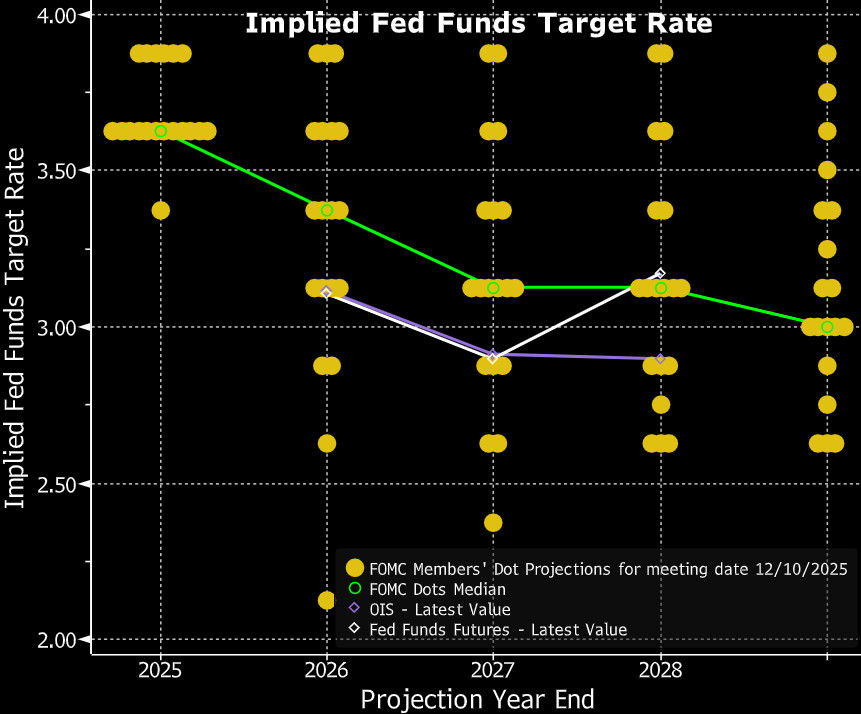
The FOMC publishes forecasts on certain economic indicators and how the policy rate may change in the future at four of its eight meetings held throughout the year. The meeting scheduled for March 17-18 will be one of these. Therefore, these documents, which will be released simultaneously with the interest rate decision, will constitute another important set of information that will impact prices.
The Fed’s view on the health of the economy is, of course, very important. We can understand this perspective by examining how officials expect macroeconomic data to change in the coming period. Changes in forecasts will be closely monitored, and in particular, possible updates to the PCE price index (the indicator the Fed uses to track inflation) will provide information about the path of interest rate cuts. A strong upward revision could mean that the Fed will not be overly hasty in cutting interest rates in the coming period, while a downward revision could imply that it may implement relatively faster cuts.
Source: Bloomberg
Within the same document, there will be a table known as a “dot plot” showing FOMC members’ projections regarding changes in the policy interest rate. In the image above and also in the table below, you can see the average expected rates formed by the dot plot published at the December meeting.

Source: Bloomberg
Markets currently expect the Fed to implement a 25 basis point rate cut at its July meeting. Another cut is then priced in for October. It is not unusual for these expectations to change in light of new developments and data. The key point to note is that the FOMC is expected to decide on two 25-basis-point interest rate cuts by the end of the year. Changes in the dot plot, which could lead to changes in this forecast, may cause a reshuffling of the cards in the markets and a change in pricing behavior.
As we will see in the dot plot table, a general downward revision in interest rate expectations, coupled with weak dollar demand, could complete the equation for digital assets gaining value. An upward revision, on the other hand, could have the opposite effect.
3- Fed Chair Powell’s Presentation: Half an hour after the FOMC statement, policy interest rate decision, economic projections, and dot plot table are announced, all eyes will turn to Chair Powell’s press conference. Powell will first explain the decisions and their rationale from behind the podium, and then move on to the section where questions from the press will be accepted. Volatility in prices may increase during this segment.
The significance of the Chairman’s speech will vary depending on the form of the decisions we outlined above. However, the messages Powell conveys regarding how the interest rate cut path will shape up in the coming periods will be critical.
If Powell signals that interest rate cuts will be necessary in 2026, we will see this reflect positively on digital assets. Conversely, we may see pressure on Bitcoin. It should also be noted that Powell’s term ends in May this year. Therefore, it would be more accurate to evaluate Powell’s statements within this projection and investment horizon.
*General Information About Forecasts
In addition to general market expectations, the forecasts shared in this report are based on econometric modelling tools developed by our research department. Different structures were considered for each indicator, and appropriate regression models were constructed in line with data frequency (monthly/quarterly), leading economic indicators, and data history.
The fundamental approach in all models is to interpret historical relationships based on data and to produce forecasts that have predictive power using current data. The performance of the models used is measured by standard metrics such as mean absolute error (MAE) and is regularly re-evaluated and improved. While the outputs of the models guide our economic analysis, they also aim to contribute to strategic decision-making processes for our investors and business partners. Data is sourced directly from the FRED (Federal Reserve Economic Data) platform in an up-to-date and automated manner, ensuring every forecast is based on the latest economic data. As the research department, we are also working on artificial intelligence-based modelling methods (e.g., Random Forest, Lasso/Ridge regressions, ensemble models) to improve forecast accuracy and react more sensitively to market dynamics. The macroeconomic context should be considered when interpreting model outputs, and it should be noted that forecast performance may deviate due to economic shocks, policy changes, and unforeseen external factors. With this monthly updated working set, we aim to provide a more transparent, consistent, and data-driven basis for monitoring the macroeconomic outlook and strengthening decision support processes.
Legal Notice
The investment information, comments, and recommendations contained in this document do not constitute investment advisory services. Investment advisory services are provided by authorized institutions on a personal basis, taking into account the risk and return preferences of individuals. The comments and recommendations contained in this document are of a general nature. These recommendations may not be suitable for your financial situation and risk and return preferences. Therefore, making an investment decision based solely on the information contained in this document may not result in outcomes that align with your expectations.